Pages

Showing posts with label activism. Show all posts

Trademarking Health At Every Size

The Journal of Critical Dietetics has just published an article I co-authored with Jacqui Gingras called 'Down the Rabbit Hole: A Critique of the ® in HAES®'.

The article came about through discussions of what it meant that the Association for Size Diversity and Health (ASDAH) had trademarked the concepts Health At Every Size, and HAES.

As activists and scholars, we wanted to raise difficult and impertinent questions about who owns the movement, and about who watches the watchers. We have offered this paper as a means of creating dialogue about the trademarking. I think it also has relevance for discussions about professionalisation within grassroots social justice movements.

Critical Dietetics is an open access journal. This means that you don't have to pay to read the articles, although you do need to register on the site to access them (the other articles in this issue are really good too!). Go to the journal page to register and download the article (link at the beginning of this post). There is also space to comment on the Critical Dietetics blog.

Gingras, J. and Cooper, C. (2013) 'Down the Rabbit Hole: A Critique of the ® in HAES®', Journal of Critical Dietetics, 1(3), 2-5.

Graduating as Dr Fat

That orangey dot in the middle of the picture is me onstage being given my Doctorate at the University of Limerick in Ireland. The photo was taken yesterday. I am about to be 'capped,' that is, to have a fancy velvet hat put on my head, which marks my formal entry into the upper ranks of academia.

At the point that this picture is being taken, the Vice President is reading out the title of my thesis: 'Fat Activism: A Queer Autoethnography.' What you can't see is me beaming with delight that the words 'fat,' 'queer' and 'activism' are being treated with extreme gravitas to a large auditorium packed with people. I'm glad that these magic words were spoken and acknowledged in this really formal setting. Fat queer activism – not a joke!


Evans, Workfare and fatshion boycotts

Arcadia, which owns Evans, has been named as a participant in the UK government's Workfare programme.

Workfare is a generic term for programmes which force people to work for benefits. The fantasy is that a placement will lead to a job, but the reality is that corporations are now being propped up with free labour from people who will lose benefits if they do not comply. In theory, volunteering somewhere where you will make contacts and develop skills is a good idea. In practise people on Workfare placements find themselves forced to do the work that nobody else wants to do. When the placement ends, there is no guarantee of paid work, the company can simply 'employ' someone else, and the government picks up the bill. Workfare people are likely to be people who are already marginalised in terms of education or prospects, the scheme ensures that they will stay that way.

Evans is the UK's most visible plus-size clothing brand. Like most high street retailers in the West, Evans' company's clothes are produced cheaply in developing countries. The conditions in Arcadia's factories are unlikely to be swanky, and although the company has an ethical standard of allowing unions, many of its clothes are produced in places where there are no unions, as well as in China where independent trades unions are illegal. Evans' ethical trading standards look good on their corporate website, but reading between the lines shows that the company is anything but ethical.

Maybe this is not so surprising when you take a look at the boss of the company. Evans is owned by Sir Philip Green, a man so rich that he has someone follow him around holding his wine glass at a party so that he doesn't have to tire his own delicate hands. Green does not pay income tax on his £1.2bn salary. Nevertheless, he has been employed by the government to support its destruction of services which ensure, for example, that the very poorest people can survive.

I know that Evans' use of exploited labour in the UK and the rest of the world is unlikely to stop fatshionistas from promoting the company's products. It is galling that the original Fatshionista LiveJournal community was intended to be a place where companies like Evans could be interrogated, but that fatshionista has often come to mean a kind of vacuous and pathetically grateful consumerism that ignores the ethical implications of fat fashion. This is not to say that there are no excellent and critical fatshion resources out there, I only wish there were more. Evans' use of Workfare, the latest in a line of appalling business practises, should be a call for a boycott. This could be an amazing opportunity to flex some consumer power to force the company to behave differently. Other companies have dropped Workfare following vociferous public criticism. But the question is, do fatshionistas have it in them?

www.boycottworkfare.org

Edited to add: I can't believe I neglected to mention the gorgeous Make It Work zine by Kirsty. It's just been published and is everything Evans isn't. Snaffle a copy today.

The YMCA's Body Confidence campaign and the All Party Parliamentary Group on Body Image

The YMCA is campaigning on behalf of 'body confidence' in the UK and is supporting a number of meetings of the All Party Parliamentary Group on Body Image, which started in November and will continue through to the end of February. These meetings are open to the public and involve expert testimony from representatives of academia, mental health, youth and education services, media, fitness, fashion, health and cosmetic surgery industries.

Those not able to attend are invited to give written evidence to the All Party Parliamentary Group on Body Image via an online survey. I submitted my response to this yesterday and encourage others to do the same.

I support this campaign in vague and general terms, I'd rather it existed than not, but I have many misgivings about it. I'm offering this critique not because I think this work should go away, but because it could and should be very much stronger and more emancipatory. Here's a brief explanation of why I'm wary:

There will be no discussion with health professionals or representatives from the National Health Service other than psychiatrists and psychologists. The hectoring use of BMI charts, plans to encourage everyone from chiropodists to pharmacists to 'helpfully' enquire about your diet and exercise every time you pick up some medicine or get your bunions seen to, and the public-private partnerships being set up between the NHS and weight loss companies would suggest that this is a significant area that affects people's embodied self esteem.

I'm assuming that this group has been omitted because they don't represent the more faddish side of weight loss, but this sets up a false distinction between good and bad weight loss; some doctors advocate very low calorie diets for fat people, for example. The campaign's website talks about problematic 'quick fixes' for body image anxiety, including cosmetic surgery, steroids, and fad diets, but it does not attack weight loss in general as something that is likely to screw up your sense of body image. This echoes a previous attempt to use the British government to support an anti-diet agenda, which was tabled by Mary Evans Young in the early 1990s with the support of Alice Mahon MP. In that instance diets were attacked as detrimental to people's health and wellbeing, but weight loss was deemed acceptable for 'the obese'. Presumably dieting or poor body image is only a problem if you are normatively-sized, everyone else is fair game.

There's no mention in the campaign of alternative paradigms that are already well-established, including fat activism and Health At Every Size. No representatives of these models have been invited to speak, it is as though they don't exist when actually there's a wealth of material and expertise and experience to draw on. The lack of connection to a wider context for this sort of work makes the campaign appear superficial, ahistorical and self-aggrandising to me.

Similarly, the role of dominant ideologies are omitted. Capitalism and neoliberalism are prime reasons why so many of us do not feel at home in our bodies. Racism and oppression in general have a massive part to play in it too. Fatphobia is at the heart of why kids are measured and dieted before they've learned to tie their shoelaces. Governmentality and medicalisation are surely implicated. The broader picture is not being addressed in this campaign, instead there is a pathetic insistence that the red herrings of 'celebrity culture' or 'the media' (which is never defined, and around which we all become passive dupes rather than active consumers or producers, or involved in any other relationship to it - and yes, the bombarded by images cliché is invoked) are the problem.

The online survey through which stakeholders are invited to give written evidence to the All Party Parliamentary Group on Body Image is poorly designed and full of leading questions, sometimes you only get a line to answer a fantastically complicated question, for example, which hints at the campaign's lack of understanding of the issues involved. The language and assumptions behind some of the questions is fatphobic, for example "What are the links, if any, between obesity, eating disorders and poor body image?" implies that the three concepts are more than likely linked and stems from a particular popular discourse of fat as a product of compulsive eating, an immature coping mechanism. Because it's a government platform, and this particular government is all about a neoliberal reduction of state funding, there are many questions about the economic impact of negative body image, which can get quite wearing, as if that's the only kind of impact that matters.

The YMCA is synonymous with gym culture, are they really the best organisation to advise on developing stronger strategies around health and self-image? Gok Wan endorses the campaign, truly a turn-off for me given his own weight maintenance regime. The YMCA's interest in the campaign is to "reduce body image as a barrier to participation" which suggests that they are looking at a business case as a rationale for this work. But I don't want good body image to be a means of transforming me into a more eager consumer of gym memberships, that's not why I do the work I do, my activism is anti-capitalist! Likewise, although I see fat activism as a broad endeavour where many kinds of activities can be sustained, including All Party Parliamentary Groups, I am an anarchist and government lobbying is not my preferred location for social change.

And what does body image mean anyway? The campaign's website defines it as "our idea of how our body looks and is perceived by others" but this is so vague, faux-apolitical and unrooted as to be meaningless.

Finally, you know what? There's not a single fat person in the promotional imagery. Bah.

Looking back at Fat News, the newsletter of the Fat Women's Group, London, 93-96

I've been looking at copies of Fat News. This is a newsletter that was produced by the second Fat Women's Group in London in the early 1990s. Both the newsletter and the second incarnation of the group were my idea, I think. The group caused me a lot of pain, I had no idea what I was doing and there were also tensions towards the end of my involvement that I still don’t understand. I ended up leaving, the group changed a bit and then, as far as I know, it stopped. Whilst it helps to think of burn-out and problems with group dynamics as common pitfalls of activism, these difficult memories have made it hard to reflect.


Fat News is the only tangible artefact I have of this period. 15 copies were published March 1993 – September 1996, though I don’t think I was involved with the last few. I remember seeing copies of Shocking Pink, which was this fantastic girl's zine produced in South London in the late 1980s, and loving how it was put together irreverently. I had no idea how I could have got involved in Shocking Pink, I think I probably thought that I wouldn’t be welcome there, I was so alienated from people at that time.

I stole some of Shocking Pink's production techniques for Fat News, which was that we would invite people to write content for it, and write some ourselves, and then everyone in the group would be responsible for cutting and pasting a page and decorating it with doodles and comments. Then someone would take it to the printer (we used the National Abortion Campaign's copier) and we'd get together to collate it and post it out to subscribers. Someone else in the group would be responsible for maintaining the subscriber's list and printing out address labels. I don’t think anyone else in the group had any involvement with small press, independent or zine publishing, and I remember it always took a lot of work encouraging people to draw or write on the pages they were pasting up.

I feel pretty sad when I look at Fat News but I'm sure other people don't feel the same way. We had some great feedback for it in the group, people loved it, and I remember how important it was to make something in which people who lived far away could participate. I remember recording audio versions of it too, it was exciting to be able to make accessible media.

The Women's Library in London have a partial set of Fat News, if you’re interested in British fat activism from twenty years ago – and why wouldn't you be?! Otherwise you can come over and have a look at my precious copies.

Talking attivisimo pro grasso/fat activism in Italy

I've just come back from a trip to Italy courtesy of Soggettiva, a queer festival held in Bologna. Part of the festival was a seminar called Corpi eccentrici: bellezza, normatività e rappresentazione (Eccentric bodies: beauty, normativity and representation), where I gave a presentation.

The seminar was held in the great hall of Santa Cristina, a place which was once a convent and now houses the city's Women's Library, amongst other things. There's a separate queer library at Il Cassero, where the organisation that convenes Soggettiva and its sister festival Gender Bender, are based. Both spaces are incredibly beautiful old buildings (that's Santa Cristina in the picture, swoon eh?). I was really happy to see my book, Fat and Proud, displayed at the entrance to Santa Cristina, and glad that the seminar was fully documented and will be archived.

I spoke about queer and trans feminist fat activism, gave a few examples of things people have done, and showed some pictures. I thought it might be a bit of a surprise to see this stuff if people had never considered fat as a political identity, or thought about fat people as people with agency, community or culture. My new friend Dani, who performed a synchronous translation of my presentation into Italian, told me that fat activism is difficult to translate. There are two words that people use to talk about fat: cicci, which is the type of term of endearment that you might use if you were calling someone chubby; and grasso, which implies a more disgusting fatness. I suggested she use grasso as a reclamation of language and a defiant celebration of the presumed monstrousness of fatness, and she ended up translating fat activism as attivisimo pro grasso. It felt pretty amazing to be creating language and concepts like this, to be doing so collaboratively and, I hope, sensitively.

Dani said that feminism is a bit of a sneaky presence in Italian academia, and that there isn't a tradition of institutional support for Women's Studies, for example, even at Bologna, which is the oldest university in the world. I got the feeling that this gathering was an unusual event. My co-speakers Giorgia Aiello, Elisa Arfini, Alessia Muroni and Roberta Sassatelli were more clued-in than me about the context of the seminar, which was to consider representation of queer bodies. Their presentations looked at corporate branding, photo agencies, soap operas, lesbian art, and advertising.

My presentation was different to the others, and I didn’t spell out the crucial connection to the seminar, which is that queer and trans fat feminist activists often make their own representations. I wanted to show the everyday embeddedness of activism, how accessible it can be, how almost everyone has some kind of resource they can draw on, and how fat activism disrupts the idea that activism is always about standing in the street with a placard, or speaking rationally to power. Whilst I appreciated my co-presenters' papers, and whilst some speakers also referred to the act of making one's own imagery, what the seminar raised for me was a deep tension between a body of feminist work that is concerned with interpreting popular images and finding it lacking, and my hunger for action beyond critique. Perhaps this is a feature of academic work that is cut off from the lifeblood of activism, I don't think it is an Italian feminist approach, I see it elsewhere too, but this event in Bologna reminded me of it. Put bluntly: it's important to understand why something is shit, but the work cannot stop there, there must be creative thinking and action and change; without these qualities the work descends into pointless hand-wringing and simply reproduces the helplessness of its subjects.

Despite these reservations I feel grateful to have taken part in this work, it was exciting to be talking about queer and trans fat feminist activism in a place where English is not the first language, where people might take on these ideas and mutate them in their own way, and to encounter the work that other people are doing.

Dicke's European Workshop on Size Diversity

Fat activists in Europe, come to this!

The German fat rights group Dicke have received a grant to produce a week-long residential workshop in Berlin in May 2012.

Participation is free to EU citizens, based on shared rooms, though you will need to find deposit money that will be refunded later.

I don't know if there have been other cross-Europe fat activist gatherings on this scale, and I think this could be a great place for expanding networks and ideas.

European Workshop on Size Diversity

Bombarded by Images

I'm going to be taking part in an artist's residency in Edinburgh, 2-3 September 2011 as a member of the Bad Art Collective. Our thing is called 'Bombarded by Images'. Come and join in if you can.

NOLOSE - exciting new directions in queer and trans fat activism

NOLOSE has just announced a change in policy that feels very daring, radical and exciting in the context of how identity politics have shaped fat activism.

The policy change statement sets out who will now be welcome at NOLOSE, sets down a challenge to identity as an organising principle, and questions the notion of safe space. This last aspect is reminiscent of Queerfestival Copenhagen's No safer spaces this year, which itself may also be part of a new trend in queer organising.

How the change in policy will work in concrete terms is anybody's guess. I think there are people who will struggle and I hope that they find a way of coming to terms with these new developments. I feel very positive about the policy change, I think it's realistically considered in terms of gender and 'safety', and I like how it advocates for more multiple and intersectional fat activisms. It demonstrates shifts in genealogies of fat activism that has roots in radical lesbian feminism and shows that the work based in these histories, locations, and politics are thriving and evolving, they are really alive. Congratulations to NOLOSE for making the leap.

Here's the text of the policy change in full:

NOLOSE Policy Change: Inclusion and Moving from Identity to Intention
July 8, 2011


Gender and Who 'We' Are

NOLOSE is a volunteer-run organisation dedicated to ending the oppression of fat people and creating vibrant fat queer culture. That's been our mission since the early '90s. Since that time, our community has been defined by who 'we' are (by nature, an evolving definition).

NOLOSE started out as the National Organisation for Lesbians of SizE, firmly fixed in identity politics, as a community of fat dykes and bisexual women. As the years passed and the organisation grew, we changed our policy to include not only a broader community of queer women—dykes, lesbians and bisexual women, including trans women—but also transgender people overall. This was partially in response to the evolving gender identities of people already in our community who were marginalised under the old policy.

Since then, NOLOSE and the annual NOLOSE Conference have been explicitly trans-inclusive, inviting all fat queer women (regardless of assigned sex or gender at birth), and all fat trans and gender-variant folks and our allies of all sexual orientations, with the specific exclusion of cisgender men (men who were assigned male at birth and identify that way now).

In the years since making this change, we've become aware that the altered policy continues to marginalise transgender people by requiring that they negate parts of their identities in order to be welcomed into the conference. For example, at this time trans men who attend can do so on the basis of having been formerly identified or socialised as female, but not on the basis of being men. At best, they can attend on the basis of being trans-men, which assumes a natural divide between cisgender men and trans men. This division can be dehumanising.

While trans men are welcomed regardless of the degree to which they have undergone hormone treatment or gender confirmation surgeries, we understand that the current gender policy may not feel as welcoming to trans women who have either not yet undergone hormone treatment and surgical transition, cannot afford to, or choose not to. While our previous policies seemed to make sense for the organisation at the time, NOLOSE does not wish to police the bodies, gender identities and gender expressions of our community. Instead, we'd like create a place that welcomes people on the basis of their desire to help build fat-positive and anti-oppressive community.

Challenging Identity as a Focus

Identity politics have their use and appeal, but they've also been constricting for us and many social justice movements. Because we defined our conference as being for and by a particular group, we opened thorny questions about legitimacy, and who had the right to be present and heard. Had we not begun to challenge that definition, we would likely have had to deal with border disputes between people arguing about 'how much' of some identity one must have in order to belong. This is a common challenge in groups and movements organising for change around identity.

There are also complexities regarding representation—if we're all in the same identity category, questions will invariably arise regarding what we say we want and how we should represent ourselves—often centred on the experience of assimilation/anti-assimilation. This can easily become a politics of shame, wherein those least able or least wanting to assimilate to some normative category get left behind. This perpetuates oppression and exclusion, drawing lines through the bodies of people.

We think there's a better way for us. Rather than trying to agree about 'who we are,' we want to come together around what is desired – what kind of ethics/politics we hold, and what kind of world we want to create. In the process, we remain cognisant of the fact that because we are differently impacted by relations of oppression and privilege, we also have different imperatives and investments in making change. Rather than try to bang out an ironclad code of conduct for what that means, we ask that everyone come willing to do the necessarily messy work of trying to figure out how to do anti-oppression politics and bring about social change and justice.

Because previous definitions of who belongs and who doesn't haven't worked for us, and because we believe that our NOLOSE community is shaped by the consciousness, ideological intent, and action of our participants rather than by identity, we've decided to change the criteria for conference attendance from an identity-based one to one that's ideologically-based. This means that anyone aiming to help create a queer, fat positive, anti-racist, anti-ableist, anti-ageist, anti-classist, anti-colonialist, feminist space will be welcome at NOLOSE. In effect, this means that all people interested in building fat-positive, queer, anti-oppressive community, including cisgender men, will be welcome at NOLOSE. Nobody will be excluded on the basis of identity. This change will be implemented by the time of our next conference.

It's been a long process that brought us to this decision. We began by having several in-person discussions more than a year ago, then created a forum (held at the 2010 conference) that helped us, as a community, identify people's hopes and fears regarding opening the conference up to cisgender men. That input was the basis of several discussions to follow, including a consultation with LGBT social worker Katy Bishop (a counsellor with expertise in helping communities navigate issues of inclusion and exclusion). It was in a meeting facilitated by Katy that we outlined this new policy.

Challenging the Concept of Safety

One concern in regards to this policy that we want to specifically address is the fear of losing of what's long been called 'safe space.' This conference has often been more comfortable for white people, those with temporary physical ability, and mid-size folks, while others of us have had to field assumptions and been forced to educate those with more privilege in order to keep from becoming invisible. This isn't our idea of safety.

While we respect people's yearning for spaces that feel secure, we want to recognise that there is a distinction between being 'safe' and being 'comfortable.' In our policy considerations, we define 'safe space' as space free from physical, verbal, and emotional violence; 'comfort,' by contrast, often has more to do with lack of challenge around our preconceived beliefs, and may also be informed by individual privilege. In that sense, discomfort can be what allows us to challenge oppression and build more inclusive community. We challenge the idea that truly comfortable space is possible or even desirable.

We want a conference that lives up to social justice principles in regards to anti-violence, body size and ability, race and ethnicity, sex, gender, sexual orientation, age, and class background. We want it to be a space that's less 'comfortable' and more radical and conscious about the kind of world we all want to live in and work toward. This means sharing space that may be challenging for all of us, and in which we're accountable to each other in order to meet those challenges with compassion and strength. This means taking risks, asking questions, being willing to learn and listen, and being responsible for our own learning as well.

Moving Forward Together

We want your input on how to actualise this policy. We, the board of NOLOSE, welcome suggestions and input from you all on how to make this policy and focus change work. Since all board members are working throughout the whole conference, our availability is limited, but you may be able to check in if you want to speak one-on-one with one of us. We will also be available from 12:00-1:00 on Saturday at lunch (at a specified table, TBD), and during the Saturday 3pm workshop slot in the 'Pig' room for community members to gather and discuss the policy change with members of the NOLOSE Board of Directors. We encourage you to add your ideas, concerns, and questions to our suggestion box located at the registration table. We'll also be asking for your input on our evaluation form at the end of the conference, so be on the lookout for that.

Here's what we would especially like to hear about:
  • Suggestions for things to include in the conference mission.
  • What do you, as a community member, need to help you through this policy and focus transition?
  • Are there structural ways that the conference can respond to your needs in regards to the new policy?
We welcome you to join in this space with us. It's an ongoing adventure that'll bring its own perils, wisdom, and love with it. Thanks for sharing it with us.

The NOLOSE Board of Directors

Tara Shuai, Co-President
Galadriel Mozee, Co-President
Kim Paulus, Vice President
Rachel, Treasurer
Geleni Fontaine, Secretary
Abby Weintraub
Jen Herrington
Joe
Sondra
Zoe

The Liberated Fat Person

Dianne Rubinstein wrote a Fat Consciousness Raising Outline in 1981 and, I believe, circulated it via NAAFA. In the guide, Rubinstein offers a rationale for consciousness raising, which was one of the key organising and politicising methods of Western feminism from the 1960s to the early 1980s, broadly speaking. She offers a format for going about fat consciousness raising, which includes lists of questions and instructions on how to listen and respond. I've never been a part of a consciousness raising group, I'm a bit too young for that, so it is fascinating to see its process spelled out in such detail.

I was interested in the last set of questions Rubinstein asks, titled The Liberated Fat Person. Firstly, the language jumped out at me, especially the use of the definite article, and the past tense for 'Liberated' which imply that liberation is a fixed state that can be attained, maybe an ideal state. This contrasts current alternative thinking about fat activism or fat acceptance which is that they are ongoing, open.

Secondly, the list of questions offers an idea of what fat liberation looked like at that point in time, within a US context of feminism and rights-based organising. Some of these ideas endure, suggesting the slow moving ideology of fat politics. Again, the concepts are fairly fixed, there's not much room for ambiguity, the use of 'our' and the undefined categorisation of people as fat and thin are problematic. The language of 'Fat Liberation', presumably rooted in Women's Liberation, looks very dated now, and has been largely taken over by the term 'fat acceptance' or 'size acceptance' which I think are politically much weaker, or 'fat activism', which often implies something else.

Thirdly, it strikes me how rare it still is to come across work which is written from the standpoint of a fat libber, or fat activist. I'm talking about work which directly references these concepts and which illustrates the values and worldviews of people engaged with these pursuits.

Lastly, I like that the questions might elicit different responses over time and place. It might be fun to have a consciousness raising session in 2011, to have a go at answering them together.

The Liberated Fat Person


1. What strengths do fat people have?
2. What is a liberated fat person?
3. What are some of the problems/pressures of the liberated fat person?
4. What is the best way to deal with a fat person who is antagonistic to the fat liberation movement?
5. How do you deal with a thin person who is antagonistic to the fat liberation movement?
6. Can a fat person with 'a raised consciousness' still relate to thin people?
7. What is equality? Is that our goal?
8. What are the goals of the fat liberation movement?
9. What are the goals of your group?
10. Is c/r a political action? Is it enough?
11. What is 'closet fat'? To what extent are you?
12. What is 'closet f.a.'?
13. What have you gotten from this group? Is it what you expected?

Rubinstein, D. (1981). Fat Consciousness Raising Outline. Bellerose, NY: NAAFA.

Timeline paper zines all gone, free digital download is here

The original paper version of A Queer and Trans Fat Activist Timeline has sold out. 250 copies were distributed by my tender hands in less than three weeks. It's so exciting to me that people want this stuff!

You're out of luck if you want one of the originals now, unless you can snaffle up one of the few remaining that will be sold at Zinefest in London by Ricochet Ricochet; at NOLOSE at the beginning of July; perhaps leftovers at Re/Dress NYC, and at Plump It Up in Toronto.

But don't cry if you missed out. Copies have been circulated at around 60 zine libraries, archives and autonomous spaces worldwide where you can visit and, in some cases, borrow a copy. It's also been released under a Creative Commons licence, which means that anyone can reprint copies. On top of that, I've written a fancypants essay about it which will hopefully be published later this year. The timeline lives! If you're around northern Germany, you might want to consider a trip to Bildwechsel to see the original timeline.

That's not all! I've saved the best until last. There's now a digital download of the zine available for free and for sharing. Go to it! Treat yourself to the audio download as well, whilst you're at it, you don't have to have a visual impairment or autism to enjoy it (but it helps).

Uppity Fatty

Uppity Fatty, a sister-site to the fantastic Adipositivity Project, posted a picture of my girlfriend Kay and I.

I love how both websites generate mass archives of images of fat people, autonomous images that represent how we see ourselves. Taking self-representation into your own hands is so easy and so radical. These are images that sustain me.

Why don't you submit some pictures of yourselves?

A Queer and Trans Fat Activist Timeline zine - nearly sold out

I started out with 250 copies at the end of May and now have 20 copies remaining. That's all that's left in the photo. They've really flown out of the door. Update: They're gone now.

Some copies will be sold at Zinefest by Ricochet Ricochet, who have about ten for sale. In the US a small number of copies will be on sale at NOLOSE at the beginning of July, and there may be leftovers at Re/Dress NYC depending on how it goes at Fatlandia. In Toronto you can pick up copies via Plump It Up.

Otherwise, that's it unless anyone wants to take on the Creative Commons task of printing more of their own. There will be a download of the zine in time, but these are the last of the original beautiful paper zines, a gorgeous object to have and hold. I don't have any plans for a second edition.

How the Left failed fat

About a week ago my friend sent me a link to an article by Jennie Bristow that was published in Living Marxism when my book came out in 1998, you can read it below. My publisher at the time sent me a press packet of all the coverage my book generated, but this article wasn't in it so I never saw it. I'm glad that I didn't read it back then, the work had been a monumental struggle for me at a time when I was living a somewhat marginal life, and I would have been devastated.

I'm in a better position to talk about this stuff 13 years on. Bristow's vicious piece is callous in its response to Christina Corrigan's death, and disablist and racist to boot. Without ever having met me, she paints me as a miserable, whining wannabe victim intent on playing oppression olympics, when actually my book sets out the many ways in which fat activists resist and transform hatred, and why we do it. Bristow presents fat activism as dogmatic and American, which it certainly can be, but there's more to the picture than that. She posits the classic argument that fat is trivial compared to 'real' oppression, not least because fat is a choice. Weirdly, she demolishes me but agrees that fat hatred is real and has negative effects on people's lives – er, isn't that what I was saying? She also sets up a creepy and false bad fatty/good fatty division between me and the lovely Janice Bhend, who published my work in her magazine in the 90s. What would Bristow have made of the passages that my publisher refused to publish? The sections about fat and trans people, sex-positive feminism, SM? I imagine she would have blown a gasket. And what about my publisher's feminist censorship of those ideas? We'll never know what she would have made of that, if only she'd done her journalistic homework and spoken to me first. The best bit is where Bristow refers to "The Charlotte Coopers of this world," heheheh, yes, there are legions of us! All like me!

Bristow's article was not the first time that Living Marxism dismissed fat activism, in 1994 Ann Bradley went to town on Mary Evans Young's project of getting an anti-diet Early Day Motion read and supported in Parliament. I won't dwell on those pieces, or my book, both came out years ago and are done and done. Contexts have changed and I feel confident that Fat & Proud was a good piece of work because of the positive response I've had to it over the years.

What I do want to say is that both Bradley and Bristow's articles capture the British Left's failure to get on board with embodied liberation, including fat. This is also mirrored in some kinds of feminism (and it hasn't escaped me that both of these Living Marxism articles were authored by women). The legacy of the belittling of fat activism, and the feminist pathologising of fat within eating disorder paradigms is that the Left has a particularly muddled and weak relationship to this kind of political activity today. I see this as a wasted opportunity, a terrible shame. If the unions had supported Jane Meacham when she was sacked for being too fat in the late 1980s, we might very well have employment protection today. And how come it's left to the bloody Daily Mail to highlight dodgy goings on in the weight industry – notably a number of deaths of women who happened to be on the Lighterlife diet – whilst The Guardian continues to bleat on about the obesity epidemic long after anyone is interested?

Maybe Bristow has the answers. I wrote to her last week to see if she would like to re-engage with some of the things she said about my work in the light of how the world has since changed. As yet she hasn't responded.

Bradley, A. (1994). Fat's not a feminist issue. Living Marxism, 68, p.11

Bristow, J. (1998). The 'fat rights' lobby is out to lunch. Living Marxism, 109, p.30

PS. And I'm still pissed off that when Michael Moore solicited his TV audience for ideas, he never took up my suggestion that diet industries would be a good target for Crackers the Corporate Crime Fighting Chicken! What, hold a grudge? Me?

And while I'm at it, have a look at Depicting fat and class too.

Revisiting BBC Open Space: Fat Women Here To Stay

Although my awakening as a fat activist was spread out over a long period, and although I still feel that I am undergoing a continuous kind of awakening around it, I can pinpoint 1989 as the year when I started to wake up.

I was 20, at Uni in Aberystwyth, my mum and my brother had recently died and I was frozen with grief, and I had a horrible relationship with a guy who wanted me to lose weight. During this dismal time I got a copy of Shelley Bovey's Being Fat Is Not A Sin, I may well have come across Shadow On A Tightrope, I heard about the Fat Women's Conference and the group that organised it in London and saw them talk about it on Terry Wogan's chat show. It's possible I read the articles that Spare Rib published about this new British fat activism, and I watched the Open Space documentary Fat Women Here To Stay on BBC2.

Today, 22 years later, I watched that documentary again. There's a viewing copy at the British Film Institute so I went and paid the fee, a massive £3.60 including VAT, and a friendly technician set it up for me at a viewing station.

I don't know much about the BBC's Community Programming Unit or Open Space, although I appeared in a later Open Space documentary made by Mary Evans Young for her Dietbreakers project in the early 1990s. I think the idea was that there were a number of slots available for people in the community to make their own programmes and maintain editorial control. The programmes were then broadcast during prime time on BBC2.

Watching Fat Women Here To Stay this morning, I was struck by how much and how little had changed in two decades. I think fat activism is slightly less obscure than it was, and parts of the discourse presented by the documentary have muddled their way into more mainstream spaces. Fat people are a lot more visible too, not just as subjects of a moral panic, but also as subjects for a television industry that needs to churn out a mass of sensationalist and cheap programming. But Fat Women Here To Stay is a very different entity than, say, a fat-related shockumentary in 2011. Mainstream, prime-time programmes where fat activists, or any 'political extremists', have editorial control don't exist.

Back to the prog. It covers the ground you'd expect: reclaiming language, discrimination, clothes, health, relationships, media representations, that kind of thing. It upholds healthism in a way that would be seen as problematic today, and its critique of fashion and advertising is flimsy. It's very earnest and somewhat naive, which makes it unintentionally funny at times, though never in a mean way. The fatshion is striking, voluminous printed tops and dangly earrings are the look for fat feminism in 1989.

My life has changed beyond anything I could have imagined for myself back then and the way I watched Fat Women Here To Stay today is very different to the way I originally viewed it. It's a credit to the programme that it can keep someone's interest beyond a Fat 101 stage. Here's what I really liked:

The presence of working class, angry, dykey feminists. Although the section on Jane Meacham's fatphobic sacking was heart-breaking, her defiance, and the support of her defiant family, is and was really inspiring, so many people would be crushed by the treatment she had to face. Mandy Mudd told it like it is, and I noticed that the women were very careful with pronouns when talking about partners and relationships!

The sequence in which the London Fat Women's Group calls up the long defunct City Limits magazine and berates them for publishing fatphobic lonely hearts adverts. The Advertising Manager on the other end of the line immediately derails the conversation by alluding that the group are sell-outs for working with the BBC, to which Heather Smith replies: "There's never been a programme on British TV which has been positive about fat people, and we just have to use it as any other oppressed group would use the media, even though as a whole it may produce some oppressive programmes." God, she is on it! There's another great sequence in which, along with Barbara Shores, she tells a representative from Jenny Craig that she is a tool of The Man and takes no prisoners.

The clips of mainstream comedy shows Allo Allo and Russ Abbott denigrating fat women are fascinating(ly awful) to see. Russ Abbott interests me because his show was a platform for fat comedian Bella Emburg, so he supported a fat woman's career whilst defaming fat women in general. I don't watch much mainstream TV comedy so couldn't tell you whether fat jokes have changed since then or disappeared, maybe they've become more subtle, or maybe the way fat women are depicted has shifted more towards disgust and pity.

On the other hand, the sequence where three members of the London Fat Women's Group enthusing about Baghdad Café having just been to see it at the Curzon Soho is delightful. This is a film I love too. If I have one big criticism of the programme it is that it could do less hand-wringing and more badassery to show how life-affirming and liberating fat activism can be, especially in terms of making and consuming our own cultural production. I have been criticised by other fat activists, including my early days heroine Shelley Bovey who has since somewhat disowned the movement, for paying insufficient attention to the dreadfulness of fat experience. It can be dreadful, this is true, but I cannot live a life that is solely focussed on oppression without also taking into consideration its resistance and the necessary pleasures of making our own liveable lives through creativity and community. This is an important means if survival, a way people can thrive. In this way I think the artist Rita Keegan's presence in the programme is crucial and I wish she'd been in it more.

Anyway, at least I got to enjoy Angela English's poetry and a group of women singing a very sweet fat liberation song at the end of the programme. It's sung to the tune of Que Sera and has the lines:

Now I know women can be strong
And we must struggle to set ourselves free
Fat women healthy, happy and proud
Fighting for liberty

Que sera sera
We know that our dreams can be
The future is ours you see
We can make things change

I have some ideas why the London Fat Women's Group and the second Fat Women's Group ended, which makes watching Fat Women Here To Stay a bittersweet experience. I would really love to meet the women who made this programme, especially Heather Smith, so far our paths have never really crossed. I'm so glad this programme was made, it’s still a remarkable piece of work, and an important part of my own radicalisation.

Reporting back on the fourth and final ESRC Fat Studies and HAES Seminar

ESRC Seminar Series
Fat Studies and Health At Every Size: Bigness Beyond Obesity


Seminar Four: Researching Fat Studies and HAES: working with/as fat bodies
5-6 May 2011
Bath Royal Literary and Scientific Institution, UK


I spent a couple of days last week at the final ESRC (The Economic and Social Research Council) Fat Studies and Health At Every Size (HAES) gathering, which took place in Bath. There have been four seminars in all, stretching over about 18 months. These meetings have operated like mini conferences, and a warm and supportive community has grown up around them.

As with previous seminars, it's unfeasible to report on everything that happened, there is simply too much, so I'll just pick out a couple of the main themes.

Many of the speakers talked about autoethnography and reflexive research. Such methodologies contrast strongly with dominant research paradigms in 'obesity'. Where the latter draws upon notions of universal scientific truth and objectivity, the former disrupts such ideas by bringing the researchers themselves to the centre, by offering context, emotion, ambiguity and paradox. I particularly enjoyed Karen Throsby's presentation about her experiences researching cross-Channel swimming, which raised questions about researcher roles. Jacqui Gingras, Rachel Colls and Bethan Evans also talked about roles and ethics concerning research with and on fat people.

It is hard to imagine similar conversations happening at, say, amongst stakeholders at an obesity conference where fat people are made absent, abject, and anonymous, and where fat is automatically framed as pathology in need of professional intervention. What is remarkable about these conversations is that they took place at an interdisciplinary level and were points of contact across considerable academic difference, where tensions were able to be contained and addressed to some extent. Even better, these seminars have been open to non-academics, you know, normal people, and although some academic jargon was unavoidable, discussions emerged between people with very different experiences of and approaches to fat. Best of all, people of all sizes instigate the conversations. More mainstream obesity stakeholders would do well to stop what they're doing and listen to this dialogue.

Another seminar strand was devoted to alternative ways of presenting and conceptualising research and fat. Emma Rich, the main organiser of this seminar, invited a number of local artists and performers to showcase their work. Although few were working principally around fat or Health At Every Size, and were concerned more generally with the body, it was clear that there are exciting possibilities for fat and HAES praxis. Perhaps Vikki Chalklin came closest to this with her performance that included material from research interviews.

For me, these seminars have been much more than a series of presentations and discussions. I have experienced them as very freeing, as places of collective intellectual and political engagement, and of a scholarship that feels full of life, community and exciting potential. In 21st century Western academia these are really precious moments! My colleague and friend Bill Savage/Dr R. White has said that the ESRC Fat Studies and Health At Every Size seminars have forever spoiled us, and that other academic gatherings might be good, but they would never be as welcoming and stimulating as the ESRC experience! These seminars have been places where participants can see how things might be if we could talk about fat without having always to start at a 101-level defensive justification to hostile spectators. Having the freedom to think, speak, take risks and be heard in a gentle atmosphere has been wonderful, one of the best experiences of my academic career.

It's sad that this round of seminars has ended, although there will be some post-seminar projects, which are currently being discussed, and there may well be other Fat Studies conferences and seminars in the UK, as well as online activites. Keep your fingers crossed.

Meanwhile, deep thanks to Bethan Evans, the principle investigator, who had the idea of the seminar series and who wrote the successful funding application. Thanks also to my colleagues who organised the seminars, and to everyone who participated and supported them. And thanks to Lucy Aphramor, who closed the final seminar with an impromptu rendition of a beautifully vulnerable, funny and wavery-voiced verse from a HAES song. It really was the perfect ending.

Further information about the seminars

Government Support for Fat Studies and HAES in the UK

Reporting back on the first ESRC Fat Studies and HAES Seminar

Reporting back on the second ESRC Fat Studies and HAES Seminar

Reporting back on the third ESRC Fat Studies and HAES Seminar

ESRC Fat Studies and Health At Every Size

Fat, Sex Work, Rescue Industries

I'm very interested when other areas of critical engagement and struggle have crossovers with fat activism. I know this is controversial in terms of fat, which is seen by many as a choice and a triviality, but it fits with the earliest fat activist analyses of oppression (not that I think challenging oppression is all there is to fat activism). For example, Judith Stein's pithy two-page mimeographed introduction to fat activism places fat within a matrix of oppression and calls on fat activists to challenge other forms of oppression too. Sometimes this is lost, fat activism has been criticised for its racism, for example, but I think the idea that no one is free until everyone is free is good to bear in mind.

This week I had the pleasure of spending some time with Laura Agustìn. If you have never read Laura's book Sex at the Margins: Migration, Labour Markets and the Rescue Industry, which she authored in 2007, you must hurry and get a copy now; likewise read her blog, The Naked Anthropologist.

Although Laura is part of a wider movement, for me her book was a paradigm-changer which enabled me to recognise more deeply the agency of people who migrate and sell sex, what selling sex looks like, and how this is thwarted by the rescue industry. Laura's work has helped me unpick hyperbolic rhetoric concerning trafficking discourse, and I am grateful for her rational approach to sex work, particularly in her methodology of sex work research. It also enabled me to reconsider my own personal relationship to sex work and to connect with fat sex workers.

I live in Stratford, close to where the 2012 Olympics will be held. There are discredited reports that major sporting events result in an increase in trafficking and that evening Laura had been invited to be an expert presenter at a meeting at Waltham Forest council which was concerned with this possibility. Waltham Forest is one of the five London boroughs that is connected to the Olympics, though I live in Newham. So on Wednesday I took her to have a look at the Olympic site, and also on a mini-tour of Stratford's more obvious brothels, its sex shop and red light area, active and present long before the Olympics were announced in 2005, and just another part of the area. Fun!

I won't go on too much about the council meeting, which took place in the very formal Chamber. I'm sure minutes will be available in due course if you want to find out more about what was said in detail. Briefly, two police officers working for the Met's anti-trafficking department stated their case, as did four people who work with sex workers and migrant people, including a nun, and two medics. Varying ideological positions on sex work were represented though all could be described as 'rescue industry'. Laura spoke, and people from the council recorded and questioned the speakers. The idea that the Olympics will result in an increase in trafficking was immediately dismissed as soon as evidence to the contrary was produced. So the meeting ended up being an arena for people to state their positions and argue for their own legitimacy. No conclusion was reached, the Chair resolved to have more meetings, though this may be in question because there are local government elections looming. As an observer, I think councillors were expecting one thing but ended up having their minds blown by having to consider alternative paradigms.


As an observer, I found the meeting really interesting in a dull, committee type way. What intrigued me were the crossovers in the way that fat is presented in policymaking. Obviously there were no out sex workers present to offer their expert testimony, just as there are never autonomous fat people present during similar meetings of obesity stakeholders, it's as though the concept Nothing about us without us never existed. These gatherings are about professional management of perceived problematic populations, where there is a moral and medicalised discourse concerning embodiment, and where 'helping' is a euphemism for 'control', and where people routinely rely on duff 'evidence.' In these contexts, sex workers/fat people are talked about, made pitiful, framed as service users, are absent and Othered. Even the language has parallels: 'prostitution' sounds a lot like 'obesity' to me, 'trafficking' is as much a neologism as 'bariatric,' and 'sex work' could be seen as analogous to 'fat'. Professionals pump themselves up as essential to the discourse, medics especially so, yet it's clear that the rescuers need their fodder more than sex workers or fat people need them, for example, what do you do with massively resourced anti-trafficking units when there are no trafficked people?

Of course there are differences between the way that fat and sex work is framed in contexts such as this meeting I went to with Laura. I think fat people are far less organised than sex workers – not that fat people and sex workers are necessarily mutually exclusive groups – partly because shame is much more present. Issues concerning criminalisation and migration are also different.

Despite these differences, acknowledging common ground can be very illuminating. I would love to see broader analyses of how helping industries further marginalise their apparent constituents, for example.

What was exciting about the meeting in Waltham Forest was the way that Laura's testimony was paradigm-shifting for many people in the room. I have experienced this when I start talking about fat with people, or at least in those situations where people are more able to move beyond clichés. It's clear that many people are hungry for more complex and human ways of thinking about things that have been overstated through moral panics, and that trite accounts of trafficked women or obesity epidemics are not enough, and that ethical, grassroots ways of understanding may be possible.

Agustìn, L.M. (2007) Sex at the Margins: Migration, Labour Markets and the Rescue Industry. London: Zed Books.

Amy's friend tackles the Screaming C

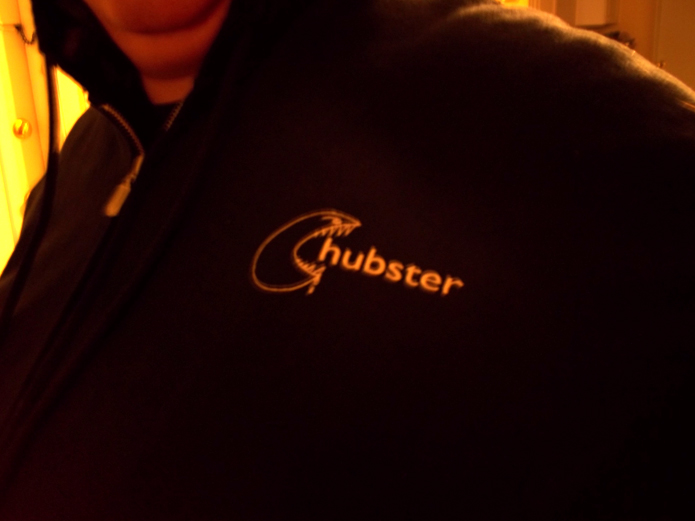
The Screaming C is one of the key Chubster symbols. It was designed by Chubsters Yeti and Big Blu at a Nolose in New Jersey in 2004. It's a letter C with blood dripping teeth, a wild eye, and a mouth full of attack.

It gives me a funny feeling inside when people go crafty with Chubster imagery. Tom O'Tottenham's Chubster stonemasonry often springs to mind, as does Chanko Nabe's needlework. Anyway, look what Amy Onigiri's friend made (the friend who must surely have a name only I don't know it yet).

Amy says:
My friend made me this great Chubster hoodie so I wanted to send you a picture but I couldn't get the camera on my new phone to work so I had to wait for hers. Anyway, somehow this hoodie is really badasss. Like I see people reading it and they start to say something and they stop like "Naaah, I better not." It's kind of hilarious. It makes me feel totally gangster even though I am, obviously, not. I cant figure out if it's the hoodie or the Chubster part of it or the combo. I love it.


Register for the final ESRC Fat Studies and HAES Seminar - FREE

ESRC seminar series: Fat Studies and HAES: Bigness Beyond Obesity
Seminar 4: Researching Fat Studies and HAES: working with/as fat bodies


5-6 May 2011, Bath Royal Literary and Scientific Institution (Elwin Room)

To register to attend the seminar please follow this link: http://www.surveymonkey.com/s/KKWV6R3

This seminar will address the ethical and methodological issues involved in researching Fat Studies and Health at Every Size and will explore possibilities for the engagement of public, activist, policy and practitioner communities in Fat Studies and HAES research.

There will be a combination of presentations, workshop activities and performance art.

The following speakers are confirmed (more to be announced asap. See the seminar series website for more details):

Keynote: Jacqui Gingras, Assistant Professor, Ryerson University.
Rachel Colls, Durham University
Bethan Evans, Durham University
Jacqueline O’Toole, Institute of Technology, Sligo
Vicky Chalkin, Goldsmiths University of London

The seminar will run from 1pm-6pm on Thursday 5 May and 9am-3pm on Friday 6 May.

The seminar is free to attend, including tea/coffee on Thursday 5 May and lunch on Friday 6 May, but participants must meet their own accommodation and transport costs. Directions to the venue can be found here: http://www.brlsi.org/about.html There is plenty of hotel accommodation available in the centre of Bath. A list of recommended hotels is available from E.Rich@bath.ac.uk

There will be an optional dinner on Thursday 5th May (costs not covered). Please indicate whether you wish to attend this on the registration form.

There are a limited number of bursaries available to contribute to travel/accommodation costs for students/unwaged participants. To request a bursary, please complete the relevant section on the registration form.

More details on the seminar series are available online here: http://www.dur.ac.uk/geography/research/researchprojects/fat_studies_and_health_at_every_size/

Any questions, please contact Emma Rich (E.Rich@bath.ac.uk), Lee Monaghan (Lee.Monaghan@ul.ie) or Bethan Evans (bethan.evans@durham.ac.uk)

Queering Fat Activism: Burger Queen

Scottee is a wunderkind of London's queer performance art scene, and also someone who makes his fat body central to his work. Take a look at his new project, Burger Queen.

What are fat activists to make of this beauty contest which revels in fast food, excess and carefree attitude? It seems a far cry from what Katie LeBesco identifies as the will to innocence in fat activism, ie the assertion that fat people are not responsible for getting fat, don't choose to be fat, and can't change. It also seems far away from healthism in fat activism, exemplified by images of beaming salad-loving, yoga-doing fat folk. It doesn't really fit more common-or-garden forms of fat activism, such as refuting health claims made against obesity, fashion consumerism, or placard-waving protests.

Burger Queen takes on the appearance of fat lib – 'fat is a politic' – but also revels in themes that would upset orthodox fat activists. I'm talking about greed, love of grease, grotesqueness, nihilism. It breaks the rules, not least because of its resident judge, Amy Lamé, who is both a great supporter of fat activism in the UK, and also appeared on Celebrity Fit Club. Intentional weight loss is a big no-no in many fat activist quarters, and weight loss reality shows have often come under fire for whatever it is they're seen to be promoting.

So what is this politic? For me there is a flimsiness about Burger Queen as a political statement. Revelling in burgers and chips as a refutation of healthism is too neat a mirror-image flip, it maintains a relationship with dominant ideas about "the obese" when it could be going off on a much weirder and wilder tangent that has nothing to do with obesity rhetoric and everything to do with creating autonomous fat culture. So for me it doesn't quite go far enough.

I'm interested in new forms of fat activism that have or don't have a relationship to feminist fat activism of the past. It's fascinating how ideas mutate and fall back on themselves. I think it's great that Scottee is not bound by what has become fat activist orthodoxy, and neither can he be neatly compartmentalised as a Bear – the only other option available to fat queer men at the moment, apparently. But I also wonder if he knows about this great movement, and if he is incorporating it into his work. For example, when Scottee raised a few eyebrows at The Fat of The Land: A Queer Chub Harvest Festival, with his apparently sincere poem about a tragic fat girl did he know that he was rubbing people (who were looking for 'positive images' of fatness) up the wrong way? Was he being ironic and confrontational? Was it something else? On the other hand, Burger Queen is absolutely coming from fat activist tradition, in which people use the forms of activism most available to them, in Scottee's case it's queer performance art. The beauty contest, too, although well-worn, has been a site for fat activism in the past.

What Burger Queen reinforces for me is my disillusionment with what I thought were the certainties of fat activism. When I started my research into the movement I was pretty sure I had a handle on what was and what was not fat activism. A couple of years on those ideas have been erased only to be replaced with a growing discontent with the side-effects of certainty: boundary-policing, intolerance, a prudishness about the down and dirty ways in which some people talk about fat or embody fat, the divisions between good fat activists and bad fat activists. So I'm keeping an open mind about Burger Queen, I'm looking forwards to seeing how it turns out, and I'm hopeful that it will be part of a queer turn in fat activism, work that messes up fat, makes it unruly and complicated, not nice, safe, or easily knowable.
 

Archives