The Basics is a series of posts covering some of the ideas that underpin the way I approach fat. I tend to take these ideas for granted, but some people are new to them, and so they need a bit of an introduction.
A fat activist is a person who thinks about fat in ways that challenge, question and critique most mainstream thinking about fat. Fat activists seek social change and consider fatness a factor within already existing matrices of oppression and liberation. Fat activists generally regard fatness as valuable, and fat people as valuable people (also legitimate, agentic, cherished, worth as much human respect as anybody else). There are many debates within fat activism about choice, weight loss, culpability, and there is immense pressure on fat people to 'become normal,' but I think a general feeling in fat activism is that the world would be a poorer place without fat people. This is a key distinction between fat activism and a discourse upholding 'obesity' which is more likely to be concerned with eradicating fat, or failing to respect the humanity of fat people.
Fat activists come from every background and have diverse ideas about what constitutes 'challenging most mainstream thinking about fat'. Often fat activists disagree with each other about what that means, often we have incompatible ideas about social change, often these ideas are rooted in our social identities. Sometimes fat activists find allies in places beyond fat activism, but it's common for broader social movements to marginalise discussions about fat; this is particularly true in the radical Left.
Fat activists act on their thoughts about challenging mainstream thinking about fat in many different ways. Sometimes acting on those thoughts means having other thoughts, other times it means speaking with other people, putting things out in the world (a blog post, a book, a letter, something tangible or consumable), making a gesture. Sometimes these actions will be easily understood as 'activism' (a demonstration, a campaign); other times they will be very small and interpersonal (a conversation, a decision to wear one kind of thing and not another); and sometimes these actions are very ambiguous (an action that tries to show the value of fat people but relies on oppressive clichés, for example, or a company that uses fat activism purely to make money). Fat activism is not only a challenge, it is also a generative movement that is concerned with creating fat culture and community. Fat activists act by themselves and with other people, they use whatever resources they have to hand: 20,000 Twitter followers, crochet, imagination, a trust fund, etc.
Fat activists are not always fat, though who and what constitutes fat is complicated and should be the subject of a different post.
Fat activism is a social movement that emerged out of civil rights discourse in the US in the late 1960s, and has strong ideological links with feminism, queerness, and disability rights activism, though few fat activists are aware of its relatively long history, or theoretical underpinnings. This is because it is sketchily documented, and also because to most people the idea of fat activism, or a social movement concerned with fat, is little more than a joke. Meanwhile, the ramping-up of anti-obesity rhetoric in the West around the turn of the millennium, combined with accessible technology and social media has accelerated fat activism into a critical discourse with many supporters.
I have offered some ideas here about what constitutes a fat activist. These ideas are based on my own experience and perspectives, and research, and should not be assumed to be carved in stone. There are countless other definitions out there. I think fat activists should continue to offer their own ideas about what fat activism is or means. Let's forget about creating a universal or monodimensional definition, which will always leave someone out in the cold, and instead keep on making a movement of wild and beautiful diversity.
PS This is what a fat activist looks like.
Showing posts with label fat activism. Show all posts
Showing posts with label fat activism. Show all posts
Aquaporko is the future of fat public health

Aquaporko! is the latest episode in the story of how fat femmes are pioneering fat activism in Australia's metropolitan hubs through synchronised swimming. Fat activism has precedents in synchro: the Padded Lillies were active in The Bay Area in the US, and highly visible for some time, but not so much lately. This and my own history as a synchronised swimmer has led me to follow Aquaporko with interest over the last three years. I first heard of them through Facebook. Kelli Jean was starting out with the idea of doing a queer fat femme synchronised swimming performance at the wonderful Coogee Women's Pool in Sydney. I showed her some basic synchro moves in London via Skype and later took part in an Aquaporko workshop at NOLOSE. Members of the Sydney Aquaporko troupe talked about their experiences at Fat Studies: A Critical Dialogue, a conference at Macquarie University in Sydney in September. Later, a Melbourne chapter got underway and it is this group that forms the focus of the documentary.
The women of Aquaporko look like they're having the time of their lives in the film. We follow them as they practise and perform a series of routines, contextualised with more in-depth interviews with the participants. Aquaporkos describe how the group has helped transform their relationship to their bodies, and how they have found community by swimming together and supporting each other. In performing, we see how Aquaporko is also developing fat space and community beyond the group, involving people of all sizes. Fat representation is usually predicated upon the image of the sad and lonely fatty, but Aquaporko is joyous and shows fat women at the heart of things, supported and loved, and anything but alienated from each other. I was really excited to see swimmer-scholar-activist Jackie Wykes talking about synchro and fat studies, placing Aquaporko in a lineage of queer fat activism (with my own books on display in the shot – proudface!). It was great to see so many people referenced in the film's credits, to acknowledge that it is the product of a movement, as well as the work of a film-maker.
My one reservation about Aquaporko is about the limitations of its cute, kitsch and retro aesthetic. I understand this as central to a particular construction of femme identity, perhaps one that is popular and recognisable to audiences in Sydney and Melbourne. I think cuteness works as an entry point for swimmers who may feel self-conscious, or are new to fat activism, but it also feels quite limiting to me, as if swimmers are trying to protect (themselves? Their audiences?) from the 'ugliness' of fat bodies. I felt that there was a tension in using cuteness, perhaps something about trying to negotiate a space for fat synchro swimmers beyond a poster girl healthism that is common to manifestations of Health At Every Size. I tried to imagine an Aquaporko routine that brought in a more raw, punk or grotesque edge, for example, where the swimmers relinquished their sweetness. Kelli Jean's own body of photographic work is often quite challenging in its representation of fatness, and I wondered if more of her aesthetic could be incorporated into the synchro.
Aquaporko currently swim in roped off lanes at public pools, even when they are performing. This physical marginalisation is perplexing to me. I see no reason why synchronised swimming could not be the new rollerderby, or even bigger: a reclaimed femme-centric community physical activity for all bodies. I think Aquaporko represents a blueprint for public health and 'obesity'. It's screamingly obvious that doing synchro in this way is empowering, health-enhancing and socially-connected, and that swimmers benefit from it enormously. Not only that, but it is inexpensive, and relatively accessible as long as there is a swimming pool nearby. Compared to the cost and risk of anti-obesity policy, and its miserable failure rate, Aquaporko is where health authorities and research institutions should be splashing their cash. But I say this with one important caveat: health promotion professionals without a grounding in community will make a mess of this and endanger it. Aquaporko is gold, but developing it into a broader movement without destroying its central qualities requires sensitivity, and power and autonomy must remain with the fat swimmers themselves.
My Guardian article on Fat Panic and Fat Activism
The Guardian has published my piece about the Academy of Medical Royal Colleges' report on obesity, which came out today with a slew of headless fatties plastered all over the media.
There's no need for this obesity epidemic hysteria
If you want to see more articles like this in the news, please consider writing to the editor and telling them how much you like my work, and how the paper should get on board with more critical work on obesity.
Edited to add: look, they put me on the front page, my whole name and all. I drew a ring around it because I can. How come Tim Lobstein gets to be called Dr and I don't?!

There's no need for this obesity epidemic hysteria
If you want to see more articles like this in the news, please consider writing to the editor and telling them how much you like my work, and how the paper should get on board with more critical work on obesity.
Edited to add: look, they put me on the front page, my whole name and all. I drew a ring around it because I can. How come Tim Lobstein gets to be called Dr and I don't?!

Fat Talks Back at WOW in London
A bunch of us are going to be on a panel about fat at the Women of the World Festival (aka WOW) in London on 10 March.
More details to come, but here's what we've got so far:
Fat Talks Back
Charlotte Cooper, Caroline Walters, Stacy Bias and maybe others to be confirmed, chaired by Corinna Tomrley.
Sunday 10 March, 12-1pm.
Women of the World Festival, 6-10 March 2013.
Edited to add:
For reasons I don't understand, this post has attracted more than the usual amount of hate mail and spam. This one is the best of the bunch: "Totally agree with all these. Unfortunately, I have met men who have had all of these traits. I am by nature a pleaser and love giving to my partner, but have learned to back off a bit and reserve that for the mn who is deserving and not selfish. When a man is really into pleasing me, it makes me want to please him even more, and it's a win-win for everyone!"
Good for you, sexy lover, are you coming to the WOW fat panel?!
More details to come, but here's what we've got so far:
Fat Talks Back
Charlotte Cooper, Caroline Walters, Stacy Bias and maybe others to be confirmed, chaired by Corinna Tomrley.
Sunday 10 March, 12-1pm.
Women of the World Festival, 6-10 March 2013.
Edited to add:
For reasons I don't understand, this post has attracted more than the usual amount of hate mail and spam. This one is the best of the bunch: "Totally agree with all these. Unfortunately, I have met men who have had all of these traits. I am by nature a pleaser and love giving to my partner, but have learned to back off a bit and reserve that for the mn who is deserving and not selfish. When a man is really into pleasing me, it makes me want to please him even more, and it's a win-win for everyone!"
Good for you, sexy lover, are you coming to the WOW fat panel?!
My fat activism and my zines
The inaugural Queer Zine Fest London was held on Saturday and it was really fantastic. Loads of people came, there was a great diversity of zine-making present, and Erica Smith, the first person to publish any of my work, gave a cracking talk about GirlFrenzy. The space hosted two excellent exhibitions alongside the event, Melanie Maddison's Shape & Situate, and Music & Liberation. It felt like a super-abundance of wonderful stuff and was seriously overwhelming.
I represented at the Fest in various ways: giving out copies of new zines; having work in the Shape & Situate exhibition and being featured as one of the "inspirational European women" in its roster (!); seeing many zines to which I have contributed, and reconnecting with folks I've met along my zine way. I also gave a little Show and Tell type talk about my life in zines.
My zine production is different to my fat activism, but they often overlap, so I talked about that a bit, and I though I'd share some if it here too.
Boyfriends and comics
I met my boyfriend Simon Murphy in 1990. He had been publishing a zine called, variously, Advenutures in Bereznik and Attack on Bereznik, since the mid-1980s. Mostly music-based, it incorporated odd articles and beautiful graphics. I had been reading similar music zines by guys for some years before meeting Simon, so we had a shared language of what constituted a zine.
In the early 1990s there was a thriving community of small press comics makers in the UK. Caption was instrumental in developing the scene, as was the Small Press Fair, and Peter Pavement's Slab-o-Concrete press in Brighton.
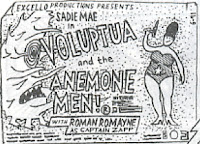 Bolstered by our shared interest in zines and small press comics, and the support of a community of makers, in 1992 Simon and I published a comic together called All Right. We made two issues, with me writing some of the scripts and Simon doing the lion's share of the work. All Right was a jumble of in-jokes, alter-egos, cuteness, and stuff that we found amusing. You can download .pdfs of it at the bottom of this page.
This is a long-winded way of saying that this was the first time that I was able to contribute to representations of myself as a young fat woman. Simon drew me as he saw me: as loveable, gorgeous, badass. My fat activism was in its early stages and it was really fun and exciting to see myself as a cartoon character. I know that other fat activists have used cartoon forms in various ways, Cindy Baker's rendition of herself as a mascot also springs to mind. For me, it was a way of playing with my fat identity and possibility for my fat self.
Contributing to zines
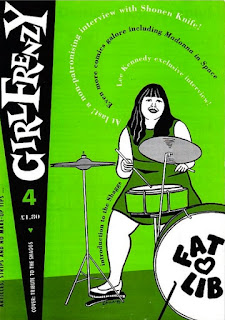 It took a long time until I had the confidence to make zines by myself. Instead, I contributed to other people's zines (I still do). This is how I started getting published. Two zines were really important in helping me build confidence in my fat activism, writing, and feeling that zines were the place for me.
GirlFrenzy was published by Erica Smith through six issues and a special one-off book-size Millennial. A small press comics magazine, GirlFrenzy was feminist but not like the other feminists I had known up until that point, it took more of a third wave, sex-positive and queer sensibility. Erica was an absolutely pivotal person in giving a huge hand-up to a community of British feminist small press comics makers, graphic artists and writers. So it was with me. GirlFrenzy was not purely focused on fat stuff, but Erica was open to discussion about it and broadly supportive. Hence number four was a special themed fat lib issue, to which I contributed.
The feminism that I encountered through GirlFrenzy orientated me to FaT GiRL, the legendary zine to which I also contributed pieces more or less throughout its lifespan. FaT GiRL was important to me in so many ways, not least that it gave me a way of understanding myself as a fat dyke, it melded fat with queer-feminist-punk ethics and aesthetics and early intersectional politics, and it introduced me to a community of people who are still very central to my life.
Living Large
This apa zine deserves a special mention because I don't know if such things exist any more. It really was of its time and place. I don't know if Living Large was typical of apa zines more generally but this is how it worked:
There was a membership group who contributed a small amount of money to get the thing printed and posted. Everyone was North American apart from me. Every month or so we'd write a little column and send it off. This usually took the form of an open letter to other members detailing our news, flyers and ephemera we'd come across, and direct comments to other people. Living Large was all about fat, so that was the focus of the things we'd write, sometimes it was about our opinions, but mostly it was about how fat impacted on our lives and the everyday activism we undertook around that. A central mailer would copy and collate the contributions and mail them out to everybody, stapled together as a zine.
Living Large was like the paper version of an email list or a messageboard. It meant that we had a little community of contributors in discussion with each other over months and years. Because it was a closed community, in as much as you had to contribute a little photocopying and postage money, the conversations were quite intimate and friendly.
I was a part of Living Large for a couple of years at least in the mid-1990s. I don't know what happened to my back issues, but it had been going for quite a while before me. I have number 44 on my desk. The internet meant that Living Large eventually became redundant, but in its prime it was a great way of keeping in touch with other fat activists across a wide geographical divide; many of us were otherwise pretty isolated.
One-offs
I've made many zines by myself and in collaboration, and some of my zines are part of a series whereas others, like these below, are one-offs that relate to fat in some way.
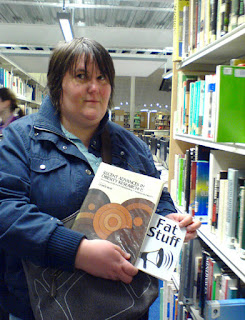 Fat Stuff
In 2006 the student services at the University of East London, where I was studying at the time, decided that it would be a good idea to host an Obesity Awareness Week, having swallowed fat panic rhetoric hook, line and sinker. Exasperated by all this, I made a tiny zine that offered a critique of Obesity Awareness Week, a list of fat activist resources available in the library, and a bunch of things people might want to do instead of participating in the uni's nonsense. I distributed them around the campus.
Things That Help Us Feel Good
In 2007 I devised and facilitated a fat activist workshop with a group of 13 and 14 year old girls for The Wellcome Institute. We made a zine together, drawing and writing a page each about what helps us feel good. I copied it and everyone got copies to keep and give away.
NOLOSE
The fat queer motherlode has supported a couple of zine projects in more recent years. In 2008 their small projects fund enabled a group of us to make a fat zine, called Big Bums, and distribute it for free.
In 2011 NOLOSE provided the impetus for my zine-based project, A Queer and Trans Fat Activist Timeline. Starting out as a fat-feminist-queer-trans community history workshop at the 2010 gathering, this morphed into an object that travelled and was discussed and archived, it became an artist's residency, from which a paper zine was produced, then an audio zine and a digital download. I also published an academic paper about the project and the way it shifted and changed.
Moving on
I've been reading and making zines for a long time, and have no plan to stop. Zines have brought me personal and professional delights. I still make my own, and write for other people's zines. I still try and work on the basis of making something for free, with low production values. What's changed over the years is that now I am more serious about distributing and archiving my work, and I'm considering longer-form digital publishing. Zines are the place where I am most myself, where I say what I really think, and where I'm least apologetic, including how I talk about fat.
If you want a copy of my most recent zine, Report, about the schools that I went to and how they tried to mould me, Paypal me €2/US CA AUS $2/ £1 for postage at beefergrrl@hotmail.com
I represented at the Fest in various ways: giving out copies of new zines; having work in the Shape & Situate exhibition and being featured as one of the "inspirational European women" in its roster (!); seeing many zines to which I have contributed, and reconnecting with folks I've met along my zine way. I also gave a little Show and Tell type talk about my life in zines.
My zine production is different to my fat activism, but they often overlap, so I talked about that a bit, and I though I'd share some if it here too.
Boyfriends and comics
I met my boyfriend Simon Murphy in 1990. He had been publishing a zine called, variously, Advenutures in Bereznik and Attack on Bereznik, since the mid-1980s. Mostly music-based, it incorporated odd articles and beautiful graphics. I had been reading similar music zines by guys for some years before meeting Simon, so we had a shared language of what constituted a zine.
In the early 1990s there was a thriving community of small press comics makers in the UK. Caption was instrumental in developing the scene, as was the Small Press Fair, and Peter Pavement's Slab-o-Concrete press in Brighton.

This is a long-winded way of saying that this was the first time that I was able to contribute to representations of myself as a young fat woman. Simon drew me as he saw me: as loveable, gorgeous, badass. My fat activism was in its early stages and it was really fun and exciting to see myself as a cartoon character. I know that other fat activists have used cartoon forms in various ways, Cindy Baker's rendition of herself as a mascot also springs to mind. For me, it was a way of playing with my fat identity and possibility for my fat self.
Contributing to zines

GirlFrenzy was published by Erica Smith through six issues and a special one-off book-size Millennial. A small press comics magazine, GirlFrenzy was feminist but not like the other feminists I had known up until that point, it took more of a third wave, sex-positive and queer sensibility. Erica was an absolutely pivotal person in giving a huge hand-up to a community of British feminist small press comics makers, graphic artists and writers. So it was with me. GirlFrenzy was not purely focused on fat stuff, but Erica was open to discussion about it and broadly supportive. Hence number four was a special themed fat lib issue, to which I contributed.
The feminism that I encountered through GirlFrenzy orientated me to FaT GiRL, the legendary zine to which I also contributed pieces more or less throughout its lifespan. FaT GiRL was important to me in so many ways, not least that it gave me a way of understanding myself as a fat dyke, it melded fat with queer-feminist-punk ethics and aesthetics and early intersectional politics, and it introduced me to a community of people who are still very central to my life.
Living Large
This apa zine deserves a special mention because I don't know if such things exist any more. It really was of its time and place. I don't know if Living Large was typical of apa zines more generally but this is how it worked:
There was a membership group who contributed a small amount of money to get the thing printed and posted. Everyone was North American apart from me. Every month or so we'd write a little column and send it off. This usually took the form of an open letter to other members detailing our news, flyers and ephemera we'd come across, and direct comments to other people. Living Large was all about fat, so that was the focus of the things we'd write, sometimes it was about our opinions, but mostly it was about how fat impacted on our lives and the everyday activism we undertook around that. A central mailer would copy and collate the contributions and mail them out to everybody, stapled together as a zine.
Living Large was like the paper version of an email list or a messageboard. It meant that we had a little community of contributors in discussion with each other over months and years. Because it was a closed community, in as much as you had to contribute a little photocopying and postage money, the conversations were quite intimate and friendly.
I was a part of Living Large for a couple of years at least in the mid-1990s. I don't know what happened to my back issues, but it had been going for quite a while before me. I have number 44 on my desk. The internet meant that Living Large eventually became redundant, but in its prime it was a great way of keeping in touch with other fat activists across a wide geographical divide; many of us were otherwise pretty isolated.
One-offs
I've made many zines by myself and in collaboration, and some of my zines are part of a series whereas others, like these below, are one-offs that relate to fat in some way.

In 2006 the student services at the University of East London, where I was studying at the time, decided that it would be a good idea to host an Obesity Awareness Week, having swallowed fat panic rhetoric hook, line and sinker. Exasperated by all this, I made a tiny zine that offered a critique of Obesity Awareness Week, a list of fat activist resources available in the library, and a bunch of things people might want to do instead of participating in the uni's nonsense. I distributed them around the campus.
Things That Help Us Feel Good
In 2007 I devised and facilitated a fat activist workshop with a group of 13 and 14 year old girls for The Wellcome Institute. We made a zine together, drawing and writing a page each about what helps us feel good. I copied it and everyone got copies to keep and give away.
NOLOSE
The fat queer motherlode has supported a couple of zine projects in more recent years. In 2008 their small projects fund enabled a group of us to make a fat zine, called Big Bums, and distribute it for free.
In 2011 NOLOSE provided the impetus for my zine-based project, A Queer and Trans Fat Activist Timeline. Starting out as a fat-feminist-queer-trans community history workshop at the 2010 gathering, this morphed into an object that travelled and was discussed and archived, it became an artist's residency, from which a paper zine was produced, then an audio zine and a digital download. I also published an academic paper about the project and the way it shifted and changed.
Moving on
I've been reading and making zines for a long time, and have no plan to stop. Zines have brought me personal and professional delights. I still make my own, and write for other people's zines. I still try and work on the basis of making something for free, with low production values. What's changed over the years is that now I am more serious about distributing and archiving my work, and I'm considering longer-form digital publishing. Zines are the place where I am most myself, where I say what I really think, and where I'm least apologetic, including how I talk about fat.
If you want a copy of my most recent zine, Report, about the schools that I went to and how they tried to mould me, Paypal me €2/US CA AUS $2/ £1 for postage at beefergrrl@hotmail.com
It's Dr Charlotte, Dr Fat from now on

Just over a week ago, I went to Ireland to sit the final oral exam for the PhD. I passed. Today I went to get my thesis bound and sent it off to meet the deadline for the Winter Exam Board at Limerick. There are a couple of formalities to go, and a graduation ceremony in January, but from about now onwards people can start to think about calling me Dr Charlotte. Dr Fat will do too.
Over four years I have worked really hard. As well as producing a 100,000 word thesis, an original argument based in original research, I have published peer-reviewed journal articles, chapters in edited books, and lots of other kinds of articles. I have given many conference papers, a handful of keynotes, and was proud to talk about my work at a fantastic gathering in Toronto earlier this year. I've produced and guested at workshops, made films that have shown at film festivals around the world, organised events, done a couple of artist residencies and a visiting scholarship. I've collaborated on projects with people, been involved with academic publishing in various ways, been the subject of quite a bit of media coverage, and maintained this blog. I can't count the number of conversations and emails that have happened because of this research, and I have been amazingly supported by people who want to see it out there in the world.
By the way, the work that I have produced is, as far as I know, the first publicly-funded, community based, major research project into fat activism. I am proud of that.
I'm sure I'll write more about the study as time passes. I'm looking for a publisher at the moment too, and would appreciate leads relating to that, if you have them to share. I have some plans for the future as well, but I'm not ready to explain them yet.
Meanwhile, here's the abstract for the thesis, to give you more of an idea of what I've been up to.
Abstract
Fat Activism: A Queer Autoethnography
Charlotte Cooper
Over my 20 year involvement with the movement, I have come to notice that scant attention is paid to fat activism. Despite intensified interest in fat in 21st century Western culture, the richness of fat activism is not reflected in a somewhat meagre literature, and fat activists themselves have offered few reflective or analytic accounts that deal with the depth and breadth of what they do.
Fat activism offers tools with which marginalised people can adapt and develop agency, community and capital, and contribute to social change. It has the potential to transform obesity policy from that which further entrenches fat people's abjection expensively, to that which builds on resources more compassionately and dynamically. This research project, therefore, represents one such attempt to hasten its development and overturn the trend in which fat activism is routinely assumed, taken for granted, and dismissed by activists, researchers, and institutions.
I begin by situating the research within the existing literature and go on to clarify what fat activism is, to relate it to discourse, and to build on existing theoretical work. I argue against creating universal definitions of fat activism, and invite appreciation for its more ambiguous forms. I produce an assemblage of fat feminist origins and travels, arguing that as well as being an unlimited phenomenon, it is plural, hybrid and evolving, yet suffers from stagnation. I propose that, instead of reproducing collateral damage through discourse, queering fat activism includes many communities of interest, questions binaries, and welcomes multiple interventions.
I use a scavenged autoethnography, bringing myself and the communities of fat activists to which I belong, into this work. This methodology draws attention to standpoint in the construction of fat narratives, expresses my frustration at reproductions of fat people as lifeless and passive empirical subjects, and synthesises activism and research.
The Queerness of Fat Activism Show and Tell in London
I'm going to do a little show and tell of the presentation I gave in Toronto in June. This will be a sit-round-the-table affair, rather than me standing at a lectern in front of a packed room. There won't be a panel or a dance afterwards, but there will be lots of time for talking about this stuff and asking questions. It's part of The Weigh In, a monthly get-together for fat activists that takes place at a vegan community café in London.
The presentation is called The Queerness of Fat Activism, and it's about queer people as well as how qualities associated with queerness can illuminate fat activism.
The Weigh In Facebook Event
Thursday, 18 October 2012
19:00 - 21:00
Pogo Cafe
76 Clarence Road
London E5 8HB
FREE! All welcome.
The presentation is called The Queerness of Fat Activism, and it's about queer people as well as how qualities associated with queerness can illuminate fat activism.
The Weigh In Facebook Event
Thursday, 18 October 2012
19:00 - 21:00
Pogo Cafe
76 Clarence Road
London E5 8HB
FREE! All welcome.
This is what the Fattylympics was like
 |
| Pic by Matthew Cunningham |
Fattylympics: This is what we did
Toronto: The Queerness of Fat Activism with Charlotte Cooper

Ryerson University are hosting the event at the Gladstone Hotel. Following my talk there will be a panel discussion and then a party! ASL interpretation is provided and the venue is wheelchair accessible and supports attendant care. It's free.
Here's what I'm going to be talking about: having conducted an autoethnography of fat activism, I have found that this social movement is more complex than the literature and popular assumptions of it currently presume. In this presentation I will use 'queer' to theorise some of these complexities. I begin by acknowledging that there are many queers in my particular social networks of fat activism because of genealogies of radical lesbian fat feminism in the West. But queer can also be thought of as a series of qualities that expands fat activism. Sharing examples, I will show that a queered social movement is one where a common agenda is not necessary for social change; where being normal and nice is overrated; where sometimes the irrational is a productive course of action; and where it is possible to organise beyond the interests of dominant discourse. Queering fat activism matters because it increases access to social activism, enables people to develop liveable lives in the present, and adds to the well-being of people of all sizes.
The Queerness of Fat Activism with Charlotte Cooper
26 June 2012, Doors 6.45pm COME EARLY!
The Gladstone Hotel
1214 Queen Street West, Toronto
The Queerness of Fat Activism with Charlotte Cooper: Facebook Event
Afterparty: The Crush Project presents CHAFE
Come along if you can, and tell anyone you know who can get to Toronto. Here's what people are already saying about the event:
Charlotte Cooper will blow your mind. if you have the opportunity to see her band Homosexual Death Drive never ever ever miss it. It will do everything for you that you ever needed. I love Charlotte Cooper in ways and magnitudes that I can never express. (Allyson Mitchell)The other thing is, isn't the poster for the event fantastic! It's designed by Sam Abel, you can see more of her work at Saucy Nüdels. Would you like to see a copy of this poster on your wall, or on a noticeboard, or all over town? Download it right now!
NO REALLY I DON'T THINK PEOPLE EVEN UNDERSTAND HOW INCREDIBLE THIS IS GOING TO BE. (Chelsey Lichtawoman)
The Queerness of Fat Activism with Charlotte Cooper – poster by Sam Abel (.pdf, 4mb)
Many thanks to the School of Disability Studies, the School of Social Work, the Department of Psychology and Critical Dietetics at Ryerson, as well as the Irish Social Sciences Platform for making this happen. Thanks also to the fat and queer activists of Toronto who have created a space in which an event like this can happen.
Also, earlier this week I made a list of introductory reading about fat and queer activism for anyone that's interested. It's a real mixture of things. No tests, no pressure, read or ignore at your leisure.
Cooper, C. (1996) 'Fitting' in Bernstein, R. and Clark Silberman, S., eds., Generation Q: gays, lesbians and bisexuals born around 1969's Stonewall riots tell their stories of growing up in the age of information, Los Angeles: Alyson, 59-64.
Cooper, C. (1998) Fat & Proud: The Politics of Size. London: The Women's Press.
Cooper, C. (2009) 'Fat Activism in Ten Astonishing, Beguiling, Inspiring and Beautiful Episodes' in Tomrley, C. and Kaloski Naylor, A., eds., Fat Studies In The UK, York: Raw Nerve Books, 19-31.
Cooper, C. (2010) 'Fat is a feminist issue, but whose feminism?', [online], available: http://www.thescavenger.net/feminism-a-pop-culture/fat-is-a-feminist-issue-but-whose-feminism-90645-428.html [accessed 11 June 2012]
Cooper, C. (2010) 'Charlotte Cooper and Judy Freespirit in Conversation, June 2010', Obesity Timebomb [online], available: http://obesitytimebomb.blogspot.com/2010/09/charlotte-cooper-and-judy-freespirit-in.html [accessed 11 June 2012]
Cooper, C. (2010) 'Olympics/Uhlympics: Living in the Shadow of the Beast', thirdspace, 9(2). [Online] Available: http://www.thirdspace.ca/journal/article/view/cooper [accessed: 11 June 2012].
Cooper, C. (2011) 'A Queer and Trans Fat Activist Timeline - zine download', Obesity Timebomb [online], available: http://obesitytimebomb.blogspot.com/p/queer-and-trans-fat-activist-timeline.html [accessed 11 June 2012]
Cooper, C. (2011) 'Queer Hapas, fat activism and weight loss surgery', Obesity Timebomb [online], available: http://obesitytimebomb.blogspot.com/2011/03/queer-hapas-fat-activism-and-weight.html [accessed 11 June 2012]
Cooper, C. (2012) 'A Queer and Trans Fat Activist Timeline: Queering Fat Activist Nationality and Cultural Imperialism', Fat Studies: An Interdisciplinary Journal of Body Weight and Society, 1(1), 61-74.
Fontaine, G. (2008) 'Keynote Address: Nolose 2008 - More Than Just Fat: The Intersection of All of Our Identities', in NOLOSE, Northampton MA. [online] Available: http://www.google.co.uk/url?sa=t&rct=j&q&esrc=s&source=web&cd=1&ved=0CFUQFjAA&url=http%3A%2F%2Fwww.nolose.org%2F08%2Fgeleni_fontaine08.pdfamp;ei=ohnWT627HvC10QXqps36Aw&usg=AFQjCNFdJNL4C4bcuUVt82f7o2gTA8dxAw [accessed 11 June 2012]
Freespirit, J. (1983) 'A Day In My Life' in Schoenfielder, L. & Wieser, B. , ed. Shadow On A Tightrope: Writings By Women on Fat Oppression, San Francisco: Aunt Lute, 118-120.
Freespirit, J. (2003) 'On Ward G' in Koppelman, S., ed. The Strange History of Suzanne LaFleshe (and other stories of women and fatness), New York: The Feminist Press at the City University of New York, 153-160.
Gingras, J. R. (2009) Longing for Recognition: The Joys, Complexities, and Contradictions of Practicing Dietetics, York: Raw Nerve.
Johnston, J. and Taylor, J. (2008) 'Feminist Consumerism and Fat Activists: A Comparative Study of Grassroots Activism and the Dove Real Beauty Campaign', Signs: Journal of Women in Culture and Society, 33(4), 941-966.
LeBesco, K. (2001) 'Queering Fat Bodies/Politics' in Braziel, J. E. and LeBesco, K., eds., Bodies Out of Bounds: Fatness and Transgression, Los Angeles: University of California Press, 74-87.
LeBesco, K. (2004) Revolting Bodies: The Struggle to Redefine Fat Identity, Amherst, MA: University of Massachusetts Press.
Mitchell, A. (2005) 'Pissed Off' in Kulick, D. and Meneley, A., eds., Fat: The Anthropology of an Obsession, London: Penguin, 211-225.
Moon, M. and Kosofsky Sedgwick, E. (1994) 'Divinity: A Dossier, A Performance Piece, A Little-Understood Emotion' in Kosofsky Sedgwick, E., ed. Tendencies, Durham, NC: Duke University Press, 211-246.
Rensenbrink, G. (2010) 'Fat's no Four-letter Word: Fat Feminism and identity Politics in the 1970s and 1980s' in Levy-Navarro, E., ed. Historicizing Fat in Anglo-American Culture, Columbus OH: The Ohio State University Press, 213-243.
Rothblum, E. and Solovay, S. (2009) The Fat Studies Reader, New York: New York University Press.
Schoenfielder, L. and Wieser, B. (1983) Shadow On A Tightrope: Writings By Women on Fat Oppression, San Francisco: Aunt Lute.
Shuai, T., Mozee, G., Paulus, K., Rachel, Fontaine, G., Weintraub, A., Herrington, J., Joe, Sondra and Zoe (2011) 'NOLOSE Policy Change: Inclusion and Moving from Identity to Intention', [online], available: http://www.nolose.org/11/genderpolicy.php [accessed 11 June 2012]
Snider, S. (2009) 'Fat Girls and Size Queens: Alternative Publications and the Visualizing of Fat and Queer Eroto-politics in Contemporary American Culture' in Rothblum, E. and Solovay, S., eds., The Fat Studies Reader, New York: New York University Press, 223-230.
Stinson, S. (2004) Venus of Chalk, Ann Arbor, MI: Firebrand Books.
Tomrley, C. and Kaloski Naylor, A. (2009) Fat Studies In The UK, York: Raw Nerve Books.
White, F. R. (2012) 'Fat, Queer, Dead: 'Obesity' and the Death Drive', Somatechnics, 2(1), 1-17.
Save the date for a night of queer fat activism in Toronto
Ryerson University in Toronto are hosting me at the end of June and have organised an event around a public lecture that I'm going to give, called The Queerness of Fat Activism.
Details are being finalised, but please save the date: Tuesday 26 June, evening.
The Queerness of Fat Activism: Charlotte Cooper!
Details are being finalised, but please save the date: Tuesday 26 June, evening.
The Queerness of Fat Activism: Charlotte Cooper!
Fat, Activism and the London 2012 Olympics
I'm really delighted to have been interviewed by the Games Monitor about fat and the Olympics, including some things about the Fattylympics.
Under the radar: Fat activism and the London 2012 Olympics: An interview with Charlotte Cooper
Under the radar: Fat activism and the London 2012 Olympics: An interview with Charlotte Cooper
Fattylympics: Where we're at
It's 83 days to go until the Fattylympics and this is where we're at (on time and on budget, motherlovers...)
The Weigh In – London's monthly fat activist social

The Pogo is an anarchist vegan café in Hackney, not far from public transport and with street parking nearby. It has a ramp at the entrance, plenty of seating, and level access to the loo. The Weigh In will share the café with other users. People of all sizes are welcome to The Weigh In, it's free to attend, and there will be affordable food and drink available to buy.
The first Weigh In takes place on Thursday 19 April in the evening.
Facebook: The Weigh In
Pogo Café
Google Map
The Weigh In
Pogo Café
76 Clarence Road
London E5 8HB
Every third Thursday of the month.
Overwhelmed by Burger Queen
 |
| My fat activist cake topper |
I took part in the competition this year because I loved it as a punter in 2011 and wanted to see it close-up and to immerse myself in the various fat discourses that circulate through it. I got to show off, got some applause, got to meet folks and, best of all, got to introduce the idea that a long-standing and diverse social movement of fat people exists. I didn't win the crown, and this didn't matter; although Burger Queen is framed as a competition, it is also a feast of fat embodiment and performance, it's a funny kind of competition, in a way, and it was a pleasure to see a superfat drag queen who really really wanted to win take the title. I know she will do it justice.
This is what I did for the final: for Trend I wore an outfit inspired by the Global Obesity EpidemicTM involving high-heeled trainers, hot-pants, lots of tits, arse and belly, wreaths of rainbow fat paper doll cut-outs, a light-up tiara spelling EPIDEMIC in blobby fat letters, and a multi-coloured staff topped with a model of a Big Boy. For Talent I introduced my film Lovely and Slim, showed it, and led a singalong. For Taste I made a triple-decker fat activist cake filled with cream, roasted strawberries and topped with a tiny scene of model fat activists protesting and being kettled by a fat policeman. People, I did my work. Although it was fun to take part and generally I feel very strong in myself, there were times when I felt quite vulnerable. It brought home that it’s a big deal for people who have marginalised bodies to put yourself out there and allow yourself to be judged in front of an audience. Fat or unfat, this is some people's worst nightmare, so it's pretty amazing that Burger Queen creates a place where this can happen relatively safely.
Back in work mode, Burger Queen was a rich experience for me as a sociology researcher interested in fat activism. I see the event as a great example of fat activism because it presents multiple and queer ways of experiencing fatness; although Scottee is the main performer, it is produced by a team of people some of whom are fat and some of whom are not, for a fairly diverse audience. I love how this is mixed, and how it shows that fat is a concept relevant to people of all sizes and backgrounds. It demonstrates that there isn't one single way of doing or being fat.
It also follows the relatively undocumented fat activist tradition of cultural production and community-building. Burger Queen is truly eye-popping and immersive: from the glitter curtains, the design, to the team's uniforms, from the badges to the burgers themselves, you feel as though you've entered a different and better world when you're there. I find it very freeing to see such a great array of fat bodies in performance; sometimes this is in a big in-your-face way, such as when Scottee does his show, but it is also there in the supporting cast, from Sami behind the desk, to Rebecca at the door. To talk about shared identity might be a step too far because it's a diverse group, but what Burger Queen does is make fat visible and both extraordinary and normal.
Burger Queen is fat activism because it addresses the easy as well as the difficult. It presents basic ideas such as self-love but doesn't stop there. Here are three things I have found particularly thought-provoking:
a) In the final, Scottee asked if it's possible to be a fat activist and also be engaged with controlled eating. The answer is, of course you can, but these ambiguities tend to be sidelined in fat activist rhetoric, and have historical connections to the essentialism of Second Wave feminism from which this form of fat activism has developed. It's great to question fat activist orthodoxies and to do so in a playful and thoughtful way.
b) This year has seen Burger Queen overlap with mainstream media as Scottee and Amy Lamé have made various appearances. This has resulted in a lot of fatphobic hate towards them, from the comments from this Guardian article, to hate-filled Tweets about Amy's appearance on TV. What to do with this stuff? Perform live deconstructions to your audience is what you do, which strips them of their power to hurt. Fucking amazing. Similarly, the public performance and ridicule of Rebecca's syrupy-yet-controlling Tweets from her former Weight Watchers's leader have had me howling with laughter. Sublime is the word I'm looking for.
c) At Burger Queen people play with fat identity without much previous engagement with fat activism. There have been fatsuits. In fat lib there's a general consensus that fatsuits are a bad idea and to a large extent I agree with this. Watching people who have made fortunes on the back of their ability to conform to beauty ideals fatting up in a suit to show what life is really like for fat people is nauseating. It demeans the authenticity of fat people's voices, and adds to the stereotypes about fat bodies. But I wasn't offended by the fatsuits at Burger Queen because they were performed without malice. I really love it when people do things that are rude and irreverent, when they say the unspeakable. I imagined that fatsuit performances would be an absolute no-no in some fat activist spaces, many of them actually. But one of the things I love about Burger Queen is that nobody knows the rules, nobody's stuck, there are no party lines to toe. Everyone's having a go at articulating fat, sexuality and gender in their own way. I don't agree with everything that people present at Burger Queen but it's a wild queer ride on fat, it's breaking new ground.
Ok, that's all for now.
Confessions of a Burger Queen
Ten Reasons to Love Burger Queen
Photographs
Burger Queen
Burger Queen 2011
Burger Queen 2012 Episode One
Burger Queen 2012 Episode Two
Burger Queen 2012 Episode Three
Burger Queen 2012 Episode Four
Burger Queen 2012 Final
Propose a Fattylympics Event!
I am co-organising the Fattylympics this summer. We are looking for people to propose and create participatory events. Fancy it? Pass it on!
Propose a Fattylympics Event!
Propose a Fattylympics Event!
Judith Stein and Meridith Lawrence: Fat Feminists Share Historic Activist Recordings
 |
| Meridith Lawrence and Judith Stein |
Stein and Lawrence are partners who pioneered fat activism in and around Boston in the early 1980s through support groups and gatherings called, variously, Boston Fat Liberation, Boston Area Fat Liberation, Boston Area Fat Feminist Liberation, and Boston Area Fat Lesbians. Stein was responsible for a slew of publications about fat, lesbian feminism and Jewish identity, and her New Haggadah is included in the collection at the National Museum of American Jewish History in Philadelphia. She was also instrumental in politicising the Boston Women's Health Book Collective around fat, which led to the inclusion of fat feminism in Our Bodies Ourselves. Stein introduced many dykes to fat feminism through their presence at the Michigan Womyn's Music Festival, and through collaborations with other fat activists in the US.
During my visit, the pair shared with me recordings of a couple of radio shows they made with other contributors in 1984 and 1985 called 'Plain Talk About Fat' and '30 Big Minutes With Fat Liberation' respectively. These shows were produced for International Women's Day by a radio station at the Massachusetts Institute of Technology. Stein and Lawrence permitted me to make digital versions of the show for people to download and listen to.
Plain Talk About Fat - 1984 (.mp3 9.3mb)
30 Big Minutes With Fat Liberation - 1985 (.mp3 13mb)
I don't know about you but I find these shows beautiful, moving, funny, right-on, and a sheer pleasure to listen to. The team's creative use of radio is gorgeous, I like the non-professional nature of it, it feels very proto-DIY culture, the rough edges are what makes these recordings so special, and the lively atmosphere is delightfully contagious.
I think many fat activists today are alienated from historical fat activisms, especially pieces of work that were produced by radical lesbian feminists, and which formed the backbone of the movement for years. These recordings give a great idea of what fat feminist culture sounded like at the time, and offer hints about the forms that fat activist cultural production might take.
I'm very grateful to the lesbian feminists, many of whom were also Jewish, who helped develop and shape fat activism in its earlier incarnations. I offer deep gratitude too to Stein and Lawrence, not just for their hospitality towards me, but also for helping to build a movement that has had such a great influence on my life.
Selected publications
Stein, J. (1981) 'Fat Liberation: No Losers Here', Sojourner, 6:9, 8.
Stein, J., Sears, R., Mitchell, P., Newmark, R. & Purnell, J. (1981) 'The Political History of Fat Liberation: An Interview', The Second Wave, 3: 32-37.
Stein, J. (1982) Telling Bobbeh Meisehs: Notes on Identity and the Creation of Jewish Lesbian Culture, Cambridge, MA: Bobbeh Meisehs Press.
Stein, J. (1983) 'On Getting Strong: Notes From a Fat Woman, in Two Parts', in: Schoenfielder, L. & Wieser, B. (eds.) Shadow on a Tightrope: Writings by Women on Fat Oppression. Iowa City: Aunt Lute, 106-110.
Stein, J. (1984) A New Haggadah: A Jewish Lesbian Seder. Cambridge MA: Bobbeh Meisehs Press.
Stein, J. (1986). Get Your Foot Off My Neck: Fat Liberation. Gay Community News, 28 June 1986.
Stein, J. (1997) 'Making A Big Splash: The Pleasures of Water Aerobics' [Online]. Berkeley, CA: Radiance. Available: http://www.radiancemagazine.com/issues/1997/spring97_jstein.html [Accessed 23 January 2012].
 Plain Talk About Fat and 30 Big Minutes With Fat Liberation by Judith Stein, Meridith Lawrence et al is licensed under a Creative Commons Attribution-NonCommercial-NoDerivs 3.0 Unported License. Permissions beyond the scope of this license may be available at http://obesitytimebomb.blogspot.com. This means you can share these recordings as long as you credit them, but you can't change them or profit from them. If you want to talk about licencing issues, contact Charlotte Cooper at this blog and she will put you in touch with the people who made the original recordings.
Thanks to Simon Murphy for help with digitising the audio.
Burger Queen is back!

Why should you care? Ten Reasons to Love Burger Queen
Dates, times, tickets and entry forms are available at Burger Queen of course.
Do not miss it!
Body Love Revolutionaries Telesummits 2012
I'm taking part in a series of telesummits called Body Love Revolutionaries, about fat culture and community, organised by Golda Poretsky, which runs more or less weekly from 31 January to 28 February 2012.
On 23 February I'm going to be talking about fat and queer and, more than likely, femme with gorgeous gussies Bevin Branlandingham and Jessica Jarchow. We'll be online at 7pm GMT (use a Time Zone Converter to find out what that means for you).
What's a telesummit? I've never participated in one before but I think it's like a conference phone call where anybody can ring in but where there are invited guests who will say their piece and who will be available for questions and discussion. This particular series of telesummits is accessible via Skype, and possibly other free internet telephony applications, which means that people participating internationally and long-distance needn't rack-up huge phone bills. The downside for people outside North America, where the telesummits are being organised, is that the time difference can be quite brutal. Recordings of the telesummits will be available free for 24 hours after they take place, as long as you register, and then for a fee on a sliding scale.
Register for access details at http://www.bodyloverevolution.com
Here's the schedule for the rest of the telesummits, with a whole mess of links. All of the times are in Eastern Standard Time, use the Time Zone Converter link above for local times.
Tuesday 31 January, 8pm EST
Activism
Peggy Howell, Amanda Levitt and Marilyn Wann.
Thursday 2 February, 7pm EST
Health
Linda Bacon and Ragen Chastain.
Tuesday 7 February, 8pm EST
Fatshion
Marie Denee, Rachel Kacenjar and Yuliya Raquel.
Thursday 9 February, 8pm EST
Sex
Hanne Blank and Virgie Tovar.
Thursday 16 February, 8pm EST
Blogging
Marianne Kirby, Margitte Leah Kristjansson, and Brian Stuart.
Tuesday 21 February, 8pm EST
Fitness
Jeanette DePatie and Anna Guest-Jelley.
Thursday 23 February, 3pm EST
Fatness/Queerness
Bevin Branlandingham, Jessica Jarchow and me.
Tuesday 28 February, 8pm EST
Politics/History
Paul Campos and Amy Erdman Farrell.
You can add yourself to the Facebook Event and tell all your friends, and Tweet about it with the hashtag #blrev if you're so inclined. Golda's got it all covered.
On 23 February I'm going to be talking about fat and queer and, more than likely, femme with gorgeous gussies Bevin Branlandingham and Jessica Jarchow. We'll be online at 7pm GMT (use a Time Zone Converter to find out what that means for you).
What's a telesummit? I've never participated in one before but I think it's like a conference phone call where anybody can ring in but where there are invited guests who will say their piece and who will be available for questions and discussion. This particular series of telesummits is accessible via Skype, and possibly other free internet telephony applications, which means that people participating internationally and long-distance needn't rack-up huge phone bills. The downside for people outside North America, where the telesummits are being organised, is that the time difference can be quite brutal. Recordings of the telesummits will be available free for 24 hours after they take place, as long as you register, and then for a fee on a sliding scale.
Register for access details at http://www.bodyloverevolution.com
Here's the schedule for the rest of the telesummits, with a whole mess of links. All of the times are in Eastern Standard Time, use the Time Zone Converter link above for local times.
Tuesday 31 January, 8pm EST
Activism
Peggy Howell, Amanda Levitt and Marilyn Wann.
Thursday 2 February, 7pm EST
Health
Linda Bacon and Ragen Chastain.
Tuesday 7 February, 8pm EST
Fatshion
Marie Denee, Rachel Kacenjar and Yuliya Raquel.
Thursday 9 February, 8pm EST
Sex
Hanne Blank and Virgie Tovar.
Thursday 16 February, 8pm EST
Blogging
Marianne Kirby, Margitte Leah Kristjansson, and Brian Stuart.
Tuesday 21 February, 8pm EST
Fitness
Jeanette DePatie and Anna Guest-Jelley.
Thursday 23 February, 3pm EST
Fatness/Queerness
Bevin Branlandingham, Jessica Jarchow and me.
Tuesday 28 February, 8pm EST
Politics/History
Paul Campos and Amy Erdman Farrell.
You can add yourself to the Facebook Event and tell all your friends, and Tweet about it with the hashtag #blrev if you're so inclined. Golda's got it all covered.
Queer Fat Performer film: Go Big or Go Home
http://queerfatperformerfilm.wordpress.com
Fattist and the fat and proud brigade - language and the movement
My friend sizeoftheocean posted on Twitter the other day that she really dislikes the term 'fattist'. I also dislike this term and hoped that she, being very smart, would be able to shed light on my own ire. She said that it has a defensive tone to it and is used by people who are not otherwise into fat stuff. I agree. My own dislike also extends to its linguistic construction – yes, my snobbery knows no bounds – sexist, racist, classist, disablist/ablist, heterosexist, fattist, right? You'd think it would work because it's consistent an allies fat with other kinds of identities. But I still can't get on board with it when I have 'fat hatred,' 'fatphobia,' 'fat oppression' as means of naming the same sort of thing, concepts that are rooted in histories and cultures of fat activism, rather than something that seems tacked-on. I feel similarly about 'looksist,' which to me seems too shallow a way of describing the systemic marginalisation of people who represent difference; it's not just about the act of looking or one's 'looks'.
I've been thinking about other terms that people use to describe what I think of as 'fat stuff,' or simply 'the movement,' or even just 'fat.' 'Size acceptance' and 'fat acceptance' are popular, though they are not for me because I find them too limited; I think self-acceptance is fine, but social acceptance is not enough for me, I'm more invested in social change. I want to change things more than I want to be accepted, in fact I realise that acceptance is not something that motivates me very much at all. 'Size' or 'weight' are too euphemistic for me. I tend to use 'fat activism,' sometimes 'fat politics,' occasionally the more restrictive 'fat rights,' but often feel that I could do with more language here.
As I've been researching, I've noticed a few references to 'fat pride.' Like fattist, these tend to be made pejoratively by people who feel burned by the movement in some way, and/or by people who would be less likely to understand the association between fat pride and queer or LGBT pride movements. Here pride is a slur, fat people shouldn't be proud because it connotes arrogance, the valuing of one type over another, smugness. In this context the ultimate goal is for fat to be stripped of any value, good or bad, just let it be what it is. I agree with this to some extent, but I also think that even if there were no negative connotations to fatness, I would probably seek out some kind of pride in myself, a pride that is associated with self-respect, pleasure, confidence, feeling as though you have value. As it is, fat pride is a useful concept in the current climate, which looks unlikely to change very much any time soon, and where there are many daily attempts to stomp these feelings out of fat people.
Again, 'the fat and proud movement,' or 'the fat pride movement' are not terms that I would use these days, perhaps I have become sensitised because of these attacks. I'll never forget an interview in which Shelley Bovey talks about "the fat and proud brigade", and compares the movement to fascists. I've wondered if this is a reference to me because of the title of my first book, in which I expressed misgivings about some of her work. Brigade is an interesting addition, it implies some kind of officious, blundering Dad's Army set-up; a group of pompous buffoons. Whilst there are many pompous buffoons in fat activism, including me, not to mention other extremely annoying people, this description doesn't really fit the diversity of the movement, it is a barbed caricature.
We could probably talk about preferred terms for how people think about fat until we are blue in the face. I agree that language creates meaning and that there is a lot of language in the world that denigrates fat embodiment, there are many terms I dislike. But policing language is problematic because the contexts in which words are used vary so greatly, being forceful around good and bad words is unacceptable, it's too close to censorship. Some words work for some people and not for others, where I feel uncomfortable about language I try and look for the intention rather than blame the form of the words; often people are just a little ignorant about fat and language. What I want is more words rather than fewer, I think the more fat language there is, the easier it becomes to think and talk about fat.
Are there any linguists in the area? Can you illuminate any of this?
References
Brooks, L. (2002) 'Size Matters' [Online]. Available: http://www.shelleybovey.com/frameset.html?/sizematters.html [Accessed 9 March 2010].
Cooper, C. (1998) Fat & Proud: The Politics of Size, London: The Women's Press.
I've been thinking about other terms that people use to describe what I think of as 'fat stuff,' or simply 'the movement,' or even just 'fat.' 'Size acceptance' and 'fat acceptance' are popular, though they are not for me because I find them too limited; I think self-acceptance is fine, but social acceptance is not enough for me, I'm more invested in social change. I want to change things more than I want to be accepted, in fact I realise that acceptance is not something that motivates me very much at all. 'Size' or 'weight' are too euphemistic for me. I tend to use 'fat activism,' sometimes 'fat politics,' occasionally the more restrictive 'fat rights,' but often feel that I could do with more language here.
As I've been researching, I've noticed a few references to 'fat pride.' Like fattist, these tend to be made pejoratively by people who feel burned by the movement in some way, and/or by people who would be less likely to understand the association between fat pride and queer or LGBT pride movements. Here pride is a slur, fat people shouldn't be proud because it connotes arrogance, the valuing of one type over another, smugness. In this context the ultimate goal is for fat to be stripped of any value, good or bad, just let it be what it is. I agree with this to some extent, but I also think that even if there were no negative connotations to fatness, I would probably seek out some kind of pride in myself, a pride that is associated with self-respect, pleasure, confidence, feeling as though you have value. As it is, fat pride is a useful concept in the current climate, which looks unlikely to change very much any time soon, and where there are many daily attempts to stomp these feelings out of fat people.
Again, 'the fat and proud movement,' or 'the fat pride movement' are not terms that I would use these days, perhaps I have become sensitised because of these attacks. I'll never forget an interview in which Shelley Bovey talks about "the fat and proud brigade", and compares the movement to fascists. I've wondered if this is a reference to me because of the title of my first book, in which I expressed misgivings about some of her work. Brigade is an interesting addition, it implies some kind of officious, blundering Dad's Army set-up; a group of pompous buffoons. Whilst there are many pompous buffoons in fat activism, including me, not to mention other extremely annoying people, this description doesn't really fit the diversity of the movement, it is a barbed caricature.
We could probably talk about preferred terms for how people think about fat until we are blue in the face. I agree that language creates meaning and that there is a lot of language in the world that denigrates fat embodiment, there are many terms I dislike. But policing language is problematic because the contexts in which words are used vary so greatly, being forceful around good and bad words is unacceptable, it's too close to censorship. Some words work for some people and not for others, where I feel uncomfortable about language I try and look for the intention rather than blame the form of the words; often people are just a little ignorant about fat and language. What I want is more words rather than fewer, I think the more fat language there is, the easier it becomes to think and talk about fat.
Are there any linguists in the area? Can you illuminate any of this?
References
Brooks, L. (2002) 'Size Matters' [Online]. Available: http://www.shelleybovey.com/frameset.html?/sizematters.html [Accessed 9 March 2010].
Cooper, C. (1998) Fat & Proud: The Politics of Size, London: The Women's Press.
Subscribe to:
Posts (Atom)
 |
 |
 |
 |
 |
 |
 |
 |
 |
 |
 |
 |
 |
 |
 |


