A while back my boyfriend, Simon Murphy, brought home a comic for us to look at. I can't remember who did it or what it was about, possibly it was something by Art Spiegelman. But I do remember a little row of drawings of fat cartoon characters at the top of the page. One of them stood out: Fat Fury! I wanted to know more about him. Simon did some research and ordered some copies of the comics featuring Fat Fury, and he wrote a little piece about it for a zine that never came to be published. I liked the piece a lot, Simon agreed to me publishing it here, so have a read. PS. I'm wearing my Fat Fury t-shirt as I write this.
Herbie Popnecker: the Little Fat Nothing that saved the world (regularly)
by Simon Murphy
The comic character Herbie Popnecker first saw the light in 1958, and after several well-received appearances in the mystery comic Forbidden Worlds, he got his own title in 1962. Written by Richard Hughes under a variety of pseudonyms, and drawn by Ogden Whitney, he was very popular for a few years as the flagship title of the American Comics Group.
Herbie is not your typical comics protagonist. He is a dorky-looking boy of about 13, short and fat with glasses and apparently no friends. He seems bored most of the time, almost sleepy, and doesn’t talk much. And yet he lives a secret parallel life as one of the most famous and powerful beings in the universe, known and loved by all. He’s everybody’s favourite fatty, popular with the ladies (in whom he has no interest), but doesn’t let it go to his head.
Herbie manages this without his parents even showing the slightest glint of curiosity or suspicion. His eternally disappointed and resentful Dad sees only a "little fat nothing," even when faced with concrete evidence of his super strength or time-travelling abilities. But Herbie doesn’t suffer any of the angst of characters like Spiderman or The Thing, he just ignores his stupid parents and gets on with it. They think he is an ignorant fat lump, and their lack of interest and low expectations would be tragic in real life, but in Herbie’s world it just means he can do whatever he wants without them noticing. If they don’t love him at least they don’t cramp his style: ideal parents. Teachers and other authority figures are equally stupid, yet when transformed into costumed superhero Fat Fury he is required to put the world that rejects him in order, which he does pretty much effortlessly, with no reward or recognition. He exposes the absurdities of that world and invites you to identify with him, join him on the cool side of the generation gap and be in on the joke. In a world of nagging, pushy but out-of-touch adults, Herbie is a role model for thrill-seeking misfit kids and under-the-radar fat freaks – one of the first.
In a range of truly bizarre stories he fights crazy monsters and criminals of the past present and future, dropping worms into Chairman Mao’s mouth in one story and leading a strike of Satan’s imps in another, as well as hanging out with The Beatles, Liz Taylor, the Queen, President Johnson, Nikita Khrushchev and other real-world people. Ironically, he is less successful at fighting criminals like Hattaman, Pizzaman and Roderick Dump when disguised as Fat Fury, because Herbie is more famous than his superhero alter-ego, and he isn’t very good at the traditional hero stuff. It’s only really as Fat Fury that he is the butt of any jokes. His powers are many and varied but never really explained. Some, like walking in the sky and talking to animals, seem innate and possibly genetic. His fatness is itself the source of these powers (he loses them when a bite from a snake-beast makes him temporarily thin), while other powers are the result of sucking on a particular lollipop. He is never without a lollipop in his mouth, but his special secret power lollies are usually kept in a locked and labelled chest of drawers in his room, and occasionally on a kind of utility belt. There is one for every situation: time travel, invisibility, digging holes, super strength etc. He also has a knack for having just the right random object on him to foil the baddies and save the day.
In retrospect you can place him somewhere in the camp pop culture melting pot of the 1960s that produced the Batman and Monkees TV series, but the fact that readers identified so closely with him sets him aside I think; he is a ridiculous character, but powerful, with a message of quiet defiance for the geeks misfits and fatties who read him. He’s not exactly subversive, the comic has its fair share of the racism and sexism of the period, but 45 years after his disappearance you can still get Fat Fury t-shirts on eBay.
Simon Murphy's excellent zine about fuzz history and culture, Good Fuzzy Sounds, can be ordered via thesimonmurphy@yahoo.com Check out his occasional blog http://www.musical-den.blogspot.com
Showing posts with label cuteness. Show all posts
Disrupting fat narratives through Synchronised Swimming
A temporary change of pace...
I was into synchronised swimming when I was 11 or 12 or so. I really loved to swim anyway and used to spend hours at Hereford Baths with anyone who would go with me, and also by myself. I don't know how I met my friend Mary Anne but she was already part of the synchro group there and she encouraged me to come too.
The group was pretty small and we'd meet once a week or so in the diving pool at the Baths to practise figures and try and earn proficiency badges. The more skilled swimmers would practise their routines. Sometimes we'd all practise group routines, which we'd map out first on land in the Club Room, walking it through, using our arms to approximate leg movements. I remember a very dynamic sequence choreographed to the theme song from Hawaii-5-0, its exoticism was preposterous in the prosaic nature of our surroundings. We were encouraged to take part in competitions, I remember travelling to ancient swimming halls in cities near by, never really doing very well.
One year, possibly 1980 or 1981, the swimming pool decided to stage a water pantomime, Cinderella in fact. For those who don't know, a pantomime is a theatrical show produced in the Xmas holidays, typically featuring a set of conventions that can be traced back to Restoration theatre and Commedia dell'Arte. The Hereford Baths' water pantomime was just someone's weird idea. There was no scenery, the costumes were minimal, as was the plot, but there was a Dame, a Principle Boy and Girl, a bit of singing, some slapstick, and lots of swimming routines featuring the synchro club. I was in the chorus.
I'm remembering all this today because I've been thinking about how my identity as a fat person has developed over the years. By the time I was 11 or 12 years old my weight was already problematised in my family; I had been dieted sporadically from around seven or eight, called names, and had attention drawn to the size of my tummy. By the time I went through puberty my identity as a fat girl had solidified. My body was surveilled for fat during Physical Education sessions at school, I was being marked out as different by my schoolmates too, who also called me fat names. I was different, by this time I'd had many experiences that would make me different to my peers, but these invisible differences were less meaningful to others, instead my difference was coded through my chubby young body.
I could develop any number of these threads at this point, but I'll leave my puberty, family, school and classmates behind and come back to the swimming which is interesting to me not just because of its extreme kitsch, but also because it both supported and disrupted a gendered fat spoiled identity.
All the synchronised swimmers were girls, the oldest and best swimmers were about 16 years old. They were really powerful swimmers, very strong and athletic, and yet all I can remember about them are narratives about their perceived femininity. There was a lot of talk about make-up, tits, swimsuits, and their bodies were always there being watched and admired. They were the ones the younger swimmers aspired to, including me. I'm really struck by the whiteness of the people in the photograph above, and I'm reminded of how people in that world were generally lower class, and how synchro may have been an attempt to generate respectable feminine identities. Despite this, the leads in the water pantomime were played by two friends who interpreted Cinderella and the Prince through romanticised butch-femme synchro duets (jeez, no wonder I turned queer). I suppose what I'm getting at is that I can't dismiss this early experience of girl sport as entirely about feminine governmentality.
Synchro reinforced the problematic nature of my body. At the synchro club as well as elsewhere it was noted that I was too big, I didn't win medals, I was mediocre, I was not elegant. I compared myself to other swimmers and found myself lacking and I was frustrated by the many moves that I did not have the strength or flexibility to perform. At the same time I felt very free in the water. I loved swimming in the deep, chilly diving pool, all that deep blue liquid space around me, performing moves called Dolphin, Marlin, Swordfish, Tub, sculling this way and that. I still feel the lack and frustration of my body, but many of the physical skills I learned in the club have stayed with me, and to this day some of my greatest embodied pleasures involve swimming and water.
Perhaps most of all, these memories of doing synchro and becoming fat help me disrupt the narrative I've internalised of the fat and lazy kid. I was a very active kid, and I was still fat. The things They say I'm supposed to believe about myself just aren't true. This makes me want to disrupt and complicate those restrictive narratives even more, including the counter-narratives of perfect healthist fat poster children.
One last thing, it just occurred to me that these early experiences made it possible for things that came later, they helped me build a sense of my body's capabilities that developed into self-expression, survival, activism, sexuality, and which inform my politics and worldview somewhat profoundly. I can see a link between synchro and punk, synchro and feminism! It's so funny that the latter can feed off the former. It helps me understand how important those early embodied experiences are in terms of building confidence and agency. I'm pretty certain that Hereford's synchro team was not explicitly an incubator for the future fat activists of the UK, which is why I also doubt that those things can be taught. There's a danger of hammering it out of young people, it can't be taught by rote, that spark can't be institutionalised, they have to find embodied freedom and agency in their own way, and even then it won't be straightforward.
I was into synchronised swimming when I was 11 or 12 or so. I really loved to swim anyway and used to spend hours at Hereford Baths with anyone who would go with me, and also by myself. I don't know how I met my friend Mary Anne but she was already part of the synchro group there and she encouraged me to come too.
The group was pretty small and we'd meet once a week or so in the diving pool at the Baths to practise figures and try and earn proficiency badges. The more skilled swimmers would practise their routines. Sometimes we'd all practise group routines, which we'd map out first on land in the Club Room, walking it through, using our arms to approximate leg movements. I remember a very dynamic sequence choreographed to the theme song from Hawaii-5-0, its exoticism was preposterous in the prosaic nature of our surroundings. We were encouraged to take part in competitions, I remember travelling to ancient swimming halls in cities near by, never really doing very well.
One year, possibly 1980 or 1981, the swimming pool decided to stage a water pantomime, Cinderella in fact. For those who don't know, a pantomime is a theatrical show produced in the Xmas holidays, typically featuring a set of conventions that can be traced back to Restoration theatre and Commedia dell'Arte. The Hereford Baths' water pantomime was just someone's weird idea. There was no scenery, the costumes were minimal, as was the plot, but there was a Dame, a Principle Boy and Girl, a bit of singing, some slapstick, and lots of swimming routines featuring the synchro club. I was in the chorus.
![]() |
| I'm right in the middle of the second row from the front |
I'm remembering all this today because I've been thinking about how my identity as a fat person has developed over the years. By the time I was 11 or 12 years old my weight was already problematised in my family; I had been dieted sporadically from around seven or eight, called names, and had attention drawn to the size of my tummy. By the time I went through puberty my identity as a fat girl had solidified. My body was surveilled for fat during Physical Education sessions at school, I was being marked out as different by my schoolmates too, who also called me fat names. I was different, by this time I'd had many experiences that would make me different to my peers, but these invisible differences were less meaningful to others, instead my difference was coded through my chubby young body.
I could develop any number of these threads at this point, but I'll leave my puberty, family, school and classmates behind and come back to the swimming which is interesting to me not just because of its extreme kitsch, but also because it both supported and disrupted a gendered fat spoiled identity.
All the synchronised swimmers were girls, the oldest and best swimmers were about 16 years old. They were really powerful swimmers, very strong and athletic, and yet all I can remember about them are narratives about their perceived femininity. There was a lot of talk about make-up, tits, swimsuits, and their bodies were always there being watched and admired. They were the ones the younger swimmers aspired to, including me. I'm really struck by the whiteness of the people in the photograph above, and I'm reminded of how people in that world were generally lower class, and how synchro may have been an attempt to generate respectable feminine identities. Despite this, the leads in the water pantomime were played by two friends who interpreted Cinderella and the Prince through romanticised butch-femme synchro duets (jeez, no wonder I turned queer). I suppose what I'm getting at is that I can't dismiss this early experience of girl sport as entirely about feminine governmentality.
Synchro reinforced the problematic nature of my body. At the synchro club as well as elsewhere it was noted that I was too big, I didn't win medals, I was mediocre, I was not elegant. I compared myself to other swimmers and found myself lacking and I was frustrated by the many moves that I did not have the strength or flexibility to perform. At the same time I felt very free in the water. I loved swimming in the deep, chilly diving pool, all that deep blue liquid space around me, performing moves called Dolphin, Marlin, Swordfish, Tub, sculling this way and that. I still feel the lack and frustration of my body, but many of the physical skills I learned in the club have stayed with me, and to this day some of my greatest embodied pleasures involve swimming and water.
Perhaps most of all, these memories of doing synchro and becoming fat help me disrupt the narrative I've internalised of the fat and lazy kid. I was a very active kid, and I was still fat. The things They say I'm supposed to believe about myself just aren't true. This makes me want to disrupt and complicate those restrictive narratives even more, including the counter-narratives of perfect healthist fat poster children.
One last thing, it just occurred to me that these early experiences made it possible for things that came later, they helped me build a sense of my body's capabilities that developed into self-expression, survival, activism, sexuality, and which inform my politics and worldview somewhat profoundly. I can see a link between synchro and punk, synchro and feminism! It's so funny that the latter can feed off the former. It helps me understand how important those early embodied experiences are in terms of building confidence and agency. I'm pretty certain that Hereford's synchro team was not explicitly an incubator for the future fat activists of the UK, which is why I also doubt that those things can be taught. There's a danger of hammering it out of young people, it can't be taught by rote, that spark can't be institutionalised, they have to find embodied freedom and agency in their own way, and even then it won't be straightforward.
Fatty Animals: I do not mind fatty!!
When I was a kid I lived in Hong Kong for a couple of years as part of what I have come to understand as a weird experiment in class and colonialism. I'll explain that in more depth in Chapter Three of my memoirs, whenever I come to write them, but for now I just want to say that Hong Kong in 1976 was when I first encountered Hello Kitty and, to a seven year old girl, that stuff was like crack. I've never been able to shake the habit and as a middle-aged woman I still go gaga for hyper-cute Asian graphics. I've been lucky enough to spend time in Japan in recent years, where I have pawed and prodded my way through the country's top stationery departments.
In London, where I live, Artbox is where I go for a fix. I was there yesterday, hyperventilating greedily over pencil-cases and plastic key covers. I bought this notebook. The cover has the picture of a rabbit or a bear with fat cheeks. The text says: "Fatty Animals: I do not mind fatty!!" and on the back there are more pictures of the fat rabbit eating a biscuit, a fat bear sitting and puffing, and more text: "We like to eat and hate to move. We are fatty animals". The paper inside the notebook is unadorned.
I did a little bit of peeping and checking this afternoon. Mind Wave sells character-based stationery and cute stuff in Japan and look like the originators of Fatty Animals. If they have Fatty Animals on their site, my Japanese is not good enough to find it, but there are other websites featuring Fatty Animals products, like pencils and pencil-cases, and other notebook styles.
I was so interested to see this stuff because I think it demonstrates a popular resistance to dominant obesity discourse in Japan, a place where Western fat activists might assume there is none, and where people in the West commonly assume there are no fat people. The reiteration of fat as being caused by eating biscuits ane being lazy is problematic, but the line: "I do not mind fatty!!" is pretty amazing, I think, as both tolerance and celebration of fatness. It ties in neatly with Fat Studies work about obesity rhetoric and pets (Cooper, 1997, Kulick, 2009). I like the way that this form of engagement with obesity discourse has travelled and messes with neat assumptions about who is making fat culture, where and how. What can I say? It's excellent to see this playing out through the medium of anthropomorphic animals and cute stationery.
Cooper, C. (1997) 'Would You Put Your Best Friend on a Diet?'. Yes! London. 4:23 June/July. 14-15.
Kulick, D. (2009) 'Fat Pets', in: Tomrley, C. & Kaloski Naylor, A. (eds.) Fat Studies in the UK. York: Raw Nerve Books, 35-50.
In London, where I live, Artbox is where I go for a fix. I was there yesterday, hyperventilating greedily over pencil-cases and plastic key covers. I bought this notebook. The cover has the picture of a rabbit or a bear with fat cheeks. The text says: "Fatty Animals: I do not mind fatty!!" and on the back there are more pictures of the fat rabbit eating a biscuit, a fat bear sitting and puffing, and more text: "We like to eat and hate to move. We are fatty animals". The paper inside the notebook is unadorned.
I did a little bit of peeping and checking this afternoon. Mind Wave sells character-based stationery and cute stuff in Japan and look like the originators of Fatty Animals. If they have Fatty Animals on their site, my Japanese is not good enough to find it, but there are other websites featuring Fatty Animals products, like pencils and pencil-cases, and other notebook styles.
I was so interested to see this stuff because I think it demonstrates a popular resistance to dominant obesity discourse in Japan, a place where Western fat activists might assume there is none, and where people in the West commonly assume there are no fat people. The reiteration of fat as being caused by eating biscuits ane being lazy is problematic, but the line: "I do not mind fatty!!" is pretty amazing, I think, as both tolerance and celebration of fatness. It ties in neatly with Fat Studies work about obesity rhetoric and pets (Cooper, 1997, Kulick, 2009). I like the way that this form of engagement with obesity discourse has travelled and messes with neat assumptions about who is making fat culture, where and how. What can I say? It's excellent to see this playing out through the medium of anthropomorphic animals and cute stationery.
Cooper, C. (1997) 'Would You Put Your Best Friend on a Diet?'. Yes! London. 4:23 June/July. 14-15.
Kulick, D. (2009) 'Fat Pets', in: Tomrley, C. & Kaloski Naylor, A. (eds.) Fat Studies in the UK. York: Raw Nerve Books, 35-50.
Look at this excellent fat sculpture
I don't have much of any substance to say today, mainly because I am still buzzing from the talk at King's College London last night. Thanks to everyone who contributed to that.
What I do have, however, is this amazing picture!
It's from the cover of the May 2011 issue of Museums Journal, the magazine of the Museums Association. It's there to illustrate an article about how science museums should get more hip and goes to show that a picture of a fat person or object perks up any old thing.
It turns out that the object is a sculpture that was exhibited in the Museum for the History of Science's Steampunk exhibition. I'm not much of a Steampunk aficionado so I haven't dug very deeply into the site and haven't been able to find much information about it other than that its title is Cosmonaute and it was made by Stéphane Halleux. There are more pictures on Stéphane's site.
The magazine image is accompanied by the headline 'Brave New World,' which I like because it subverts the notion that obesity heralds the end of the world. I've documented previous artistic explorations of fat that I think have failed dismally, but this object is different. I love it, from its tiny and cute three-digit hands to its truncated feet and blank/wonderous expression. Its apparent inflatedness reminds me of the lovely Horniman Walrus, which is no bad thing. I like the way it appears to hover lightly, as though gravity is no longer relevant.
The sculpture's shape recalls friends and acquaintances who look a bit like this. It makes me think that fat activists should have tool belts, gauges, dials and protective headgear as we navigate and explore the outer reaches of culture and embodiment.
What I do have, however, is this amazing picture!
It's from the cover of the May 2011 issue of Museums Journal, the magazine of the Museums Association. It's there to illustrate an article about how science museums should get more hip and goes to show that a picture of a fat person or object perks up any old thing.
It turns out that the object is a sculpture that was exhibited in the Museum for the History of Science's Steampunk exhibition. I'm not much of a Steampunk aficionado so I haven't dug very deeply into the site and haven't been able to find much information about it other than that its title is Cosmonaute and it was made by Stéphane Halleux. There are more pictures on Stéphane's site.
The magazine image is accompanied by the headline 'Brave New World,' which I like because it subverts the notion that obesity heralds the end of the world. I've documented previous artistic explorations of fat that I think have failed dismally, but this object is different. I love it, from its tiny and cute three-digit hands to its truncated feet and blank/wonderous expression. Its apparent inflatedness reminds me of the lovely Horniman Walrus, which is no bad thing. I like the way it appears to hover lightly, as though gravity is no longer relevant.
The sculpture's shape recalls friends and acquaintances who look a bit like this. It makes me think that fat activists should have tool belts, gauges, dials and protective headgear as we navigate and explore the outer reaches of culture and embodiment.
Amy's friend tackles the Screaming C
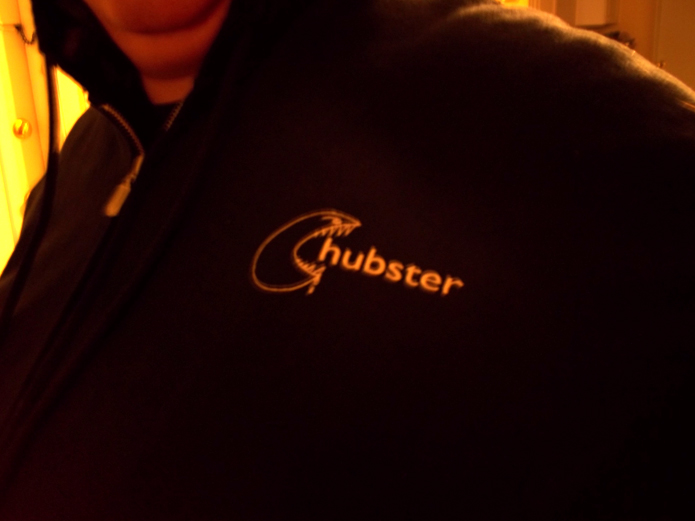
The Screaming C is one of the key Chubster symbols. It was designed by Chubsters Yeti and Big Blu at a Nolose in New Jersey in 2004. It's a letter C with blood dripping teeth, a wild eye, and a mouth full of attack.
It gives me a funny feeling inside when people go crafty with Chubster imagery. Tom O'Tottenham's Chubster stonemasonry often springs to mind, as does Chanko Nabe's needlework. Anyway, look what Amy Onigiri's friend made (the friend who must surely have a name only I don't know it yet).
Amy says:
It gives me a funny feeling inside when people go crafty with Chubster imagery. Tom O'Tottenham's Chubster stonemasonry often springs to mind, as does Chanko Nabe's needlework. Anyway, look what Amy Onigiri's friend made (the friend who must surely have a name only I don't know it yet).
Amy says:
My friend made me this great Chubster hoodie so I wanted to send you a picture but I couldn't get the camera on my new phone to work so I had to wait for hers. Anyway, somehow this hoodie is really badasss. Like I see people reading it and they start to say something and they stop like "Naaah, I better not." It's kind of hilarious. It makes me feel totally gangster even though I am, obviously, not. I cant figure out if it's the hoodie or the Chubster part of it or the combo. I love it.
Subscribe to:
Posts (Atom)